tyla homepage
  • News
  • Life
  • TV & Film
  • Beauty
  • Style
  • Home
  • News
    • Celebrity
    • Entertainment
    • Politics
    • Royal Family
  • Life
    • Animals
    • Food & Drink
    • Women's Health
    • Mental Health
    • Sex & Relationships
    • Travel
    • Real Life
  • TV & Film
    • True Crime
    • Documentaries
    • Netflix
    • BBC
    • ITV
    • Tyla Recommends
  • Beauty
    • Hair
    • Make-up
    • Skincare
  • Style
    • Home
    • Fashion
    • Shopping
  • Advertise
  • Terms
  • Privacy & Cookies
  • LADbible Group
  • LADbible
  • UNILAD
  • SPORTbible
  • GAMINGbible
  • UNILAD Tech
  • FOODbible
  • License Our Content
  • About Us & Contact
  • Jobs
  • Latest
  • Archive
  • Topics A-Z
  • Authors
Facebook
Instagram
X
Threads
TikTok
Submit Your Content
How 'orange peel' theory can signify a huge red flag in your relationship

Home> Life> Sex & Relationships

Published 12:40 24 Sep 2024 GMT+1

How 'orange peel' theory can signify a huge red flag in your relationship

The TikTok-based relationship trend has divided romance experts

Rhianna Benson

Rhianna Benson

google discoverFollow us on Google Discover
Featured Image Credit: Getty Stock Images

Topics: Sex and Relationships, Life

Rhianna Benson
Rhianna Benson

Rhianna is an Entertainment Journalist at LADbible Group, working across LADbible, UNILAD and Tyla. She has a Masters in News Journalism from the University of Salford and a Masters in Ancient History from the University of Edinburgh. She previously worked as a Celebrity Reporter for OK! and New Magazines, and as a TV Writer for Reach PLC.

X

@rhiannaBjourno

Advert

Advert

Advert

Last year, a controversial new dating trend known as the 'orange peel' theory hit headlines all over the world, and led millions of lovers to realise they were in dead-end relationships.

Now, a warning to take heed of the dangerous trend is once again being issued by romance experts, who say it can help in pointing out certain 'red flag' behaviours.

Would your other-half go above and beyond for you? (svetikd/Getty)

For those out the loop with the ins and outs of Gen Z dating, allow us to fill you in...

Advert

'Orange peel' theory was founded last winter, when a TikTok star known by the username @jennaskates revealed on the video-sharing app that her boyfriend had separated egg whites from the yolks for her, after her long-manicured hands left her unable to do it herself.

After the clip accumulated millions of views, other users were prompted to ask themselves whether their partners are prone to fulfilling equally helpful acts of service without having to be asked.

As we say, the trend has seemingly reemerged recently, with dating experts saying it can be used as a means of identifying the 'red flag' behaviour of not noticing your partner could do with a hand - one professional who chimed in was Anna Birmingham, who defined the theory.

The theory has divided relationship experts (Tim Robberts/Getty)

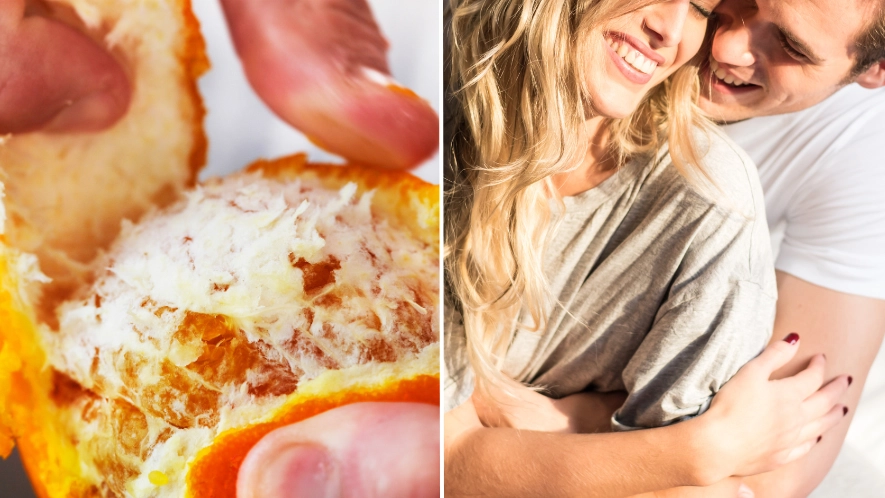
According to the dating pro, your partner's response to the question of whether or not they'd be willing to open to peel an orange for you can actually reveal 'so much about their attitude towards you and your relationship'.

Describing her own husband as the 'orange peel theory poster child', she added: "He does little things every single day without me ever having to ask for them because he genuinely likes the way that I light up when he does them."

Since then, others have shared their own experiences with the theory.

Whilst one TikToker claimed her partner always cracks open the legs of her crab when they enjoy seafood together, another revealed that her husband once wipes all the salt of a portion of chips she was eating, having accidentally sprinkled some on.

Apparently, however, not every relationship expert believes the trend to be a healthy means of testing the strength of your romance.
Some relationship experts don't agree with the theory (Drazen_/Getty)

Therapist Don Cole - who works at the Gottman Institute - dubbed the theory 'endearing', before branding the testing element both 'negative and inappropriate'.

"The whole idea in successful marriages is we don’t want to set them up to fail," he previously told The New York Times, encouraging his readers not to play games with their loved one.

Instead, he recommends simply asking or making remarks about the things you like, giving the example of telling your partner: "I love when you make me a latte in the morning."

What are your thoughts on the theory?

Choose your content:

7 hours ago
11 hours ago
12 hours ago
a day ago
  • Getty Stock Images
    7 hours ago

    List of banned sex acts in porn updated with two new categories

    People can now face prison time if caught watching two specific pornographic categories following the UK crackdown on 'harmful' content

    Life
  • Salinas Funeral Home
    11 hours ago

    Teen dies from ‘enlarged heart’ as heartbroken family blame it on energy drinks

    Larissa Nicole Rodriguez's family have filed a lawsuit seeking $1 million in damages against the energy drink distributor

    Life
  • Getty Stock Images
    12 hours ago

    Sad reason scientists want to ban boiling lobsters alive

    Scientists want the barbaric act of boiling lobsters alive to be banned, and they've confirmed something that has long been suspected

    Life
  • Getty Stock Images
    a day ago

    List of foods that will now be banned from school menus

    England’s school dinner overhaul could slash sweet treats by 2028

    Life
  • One surprising sex act that can make your period come early
  • Wedding photographer reveals major relationship red flag after 'cake smash' trend leaves bride injured
  • Two star signs people say are the ‘worst’ in bed
  • Prostatic calculi explained as common 'down there' issue can cause stinging semen