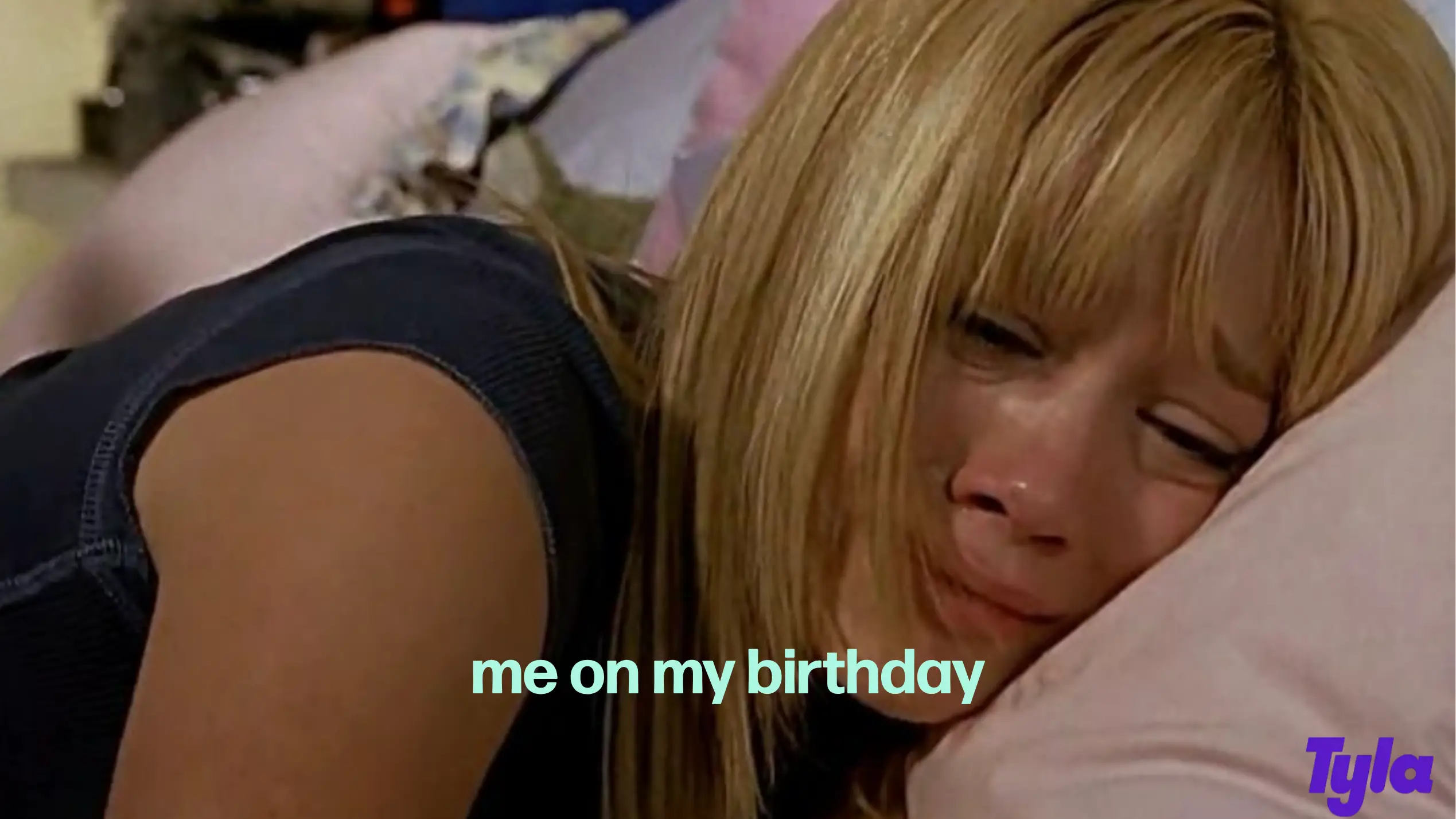
‘Zenosyne’ phenomenon explained after women complain about crying on their birthdays

Have you ever been really excited to celebrate your birthday, only to find yourself on the verge of tears for most of the day?
You wouldn't be alone in this feeling, as women from around the world have been taking to social media to discuss the strange phenomenon.
Detailing their experiences, one X user joked: "Canon event: crying on your birthday," while another wrote: "Obligatory birthday cry sesh."
Whether the tears can be brought on by happiness, sadness, nostalgia - or even for no reason at all - apparently it's something a whole lot of us experience.
Advert
There are also countless TikTok videos of women talking about their annual birthday cry and the 'birthday blues', so why do so many of us feel down on the one day that's supposed to be filled with joy and celebration?
While there's little research on the topic, psychologists have linked it to the term 'zenosyne,' which was coined by writer John Koenig for his project, The Dictionary of Obscure Sorrows.
To delve in deeper, Tyla spoke with psychologists and experts, who have shared their insight on the confusing and emotional yearly ritual.
What is Zenosyne?
Zenosyne is essentially the feeling that time is moving faster, with each year we get older.
You know when you're younger and one summer holiday can feel like it's lasted months, but as you age, the holidays fly by quicker than ever? That's Zenosyne.
It's described on the Dictionary of Obscure Sorrows website as: "Each time you circle back around, and cross the same point around the sun, and hear 'Many happy returns.' But you can already feel a shift in the pace of things, and get the feeling that each year is worth a little less than the last, as if your birthday arrives one day earlier every year."
And 'even when you’re holding still, settling down to bed at the end of a long day, it feels like you’re running somewhere' with the 'seconds slipping away'
Sound familiar?

Why do we cry on our birthdays?
This ties into the phenomenon of crying on your birthday, as it's heavily linked with this feeling of time passing.
Birthdays are milestones, and people often use them to reflect and look back at where they are in life, who they have around them, and how it compares to expectations.
Psychotherapist Claire Law, who's also a legal contributor at Custody X Change, explained to Tyla: "Birthdays could be seen as time markers when individuals become prompted for reflective thinking in regards to the passage of time, identity, and life development process.
"Reflection upon how time passes when it seems to be speeding up will inevitably lead to a sort of emotional saturation when many emotions arise simultaneously."
She reassured that crying is not necessarily 'always associated with sadness' and instead, 'it is rather an emotional reaction to too much intensity of experience'.
The expert added: "Besides, there is another phenomenon called autobiographical activation, which means that on a birthday individuals evoke different memories, comparing their expectations, present experiences, and future plans.
"Sometimes, crying is an indication that someone has successfully integrated his or her emotions. It serves as a way of regulating stress by processing his or her emotions."
Meanwhile, psychologist, Dr. Daniel Glazer, co-founder of US Therapy Rooms, explains that birthdays can trigger an 'overwhelming feeling, sometimes referred to as emotional markers.'
The expert told Tyla: "As we grow older, Zenosyne occurs when time appears to speed up. The process of creating a conscious reflection through a birthday may cause a psychological disconnect from where a person is and where he/she thought she would be by now.
"For most people, their nervous system continues to experience emotions long after the stimuli of the day has ceased. This is why so many people report crying long after they've had a great day - not necessarily due to the day itself but rather what it symbolizes."
What's more is that the 'activation of autobiographical memory networks' also occurs during birthdays.
Glazer added: "Not only are you physically celebrating your birthday, you're also emotionally recalling parts of your life. Therefore, it's possible to feel both sadness/grief, and nostalgia for something that didn't occur as well as feelings of disappointment/unfulfilled expectations; all of which can occur simultaneously."
Do only women cry on their birthdays?
Interestingly, the ritual of crying on your birthday definitely seems to be more common among women than men.
Loads of my female friends have talked about the 'birthday cry' as if it's normal and expected, but it doesn't seem to be the same widely-recognised occurrence for men.
Candace Newton, Clinical Director at Seaside Wellness, explained that women are more likely to experience the phenomenon, 'simply due to the fact that they tend to be more introspective regarding themselves and others within their social circles'.
"Women are often expected to consider their careers, families, identities etc., all at once. Therefore, they are more likely to look inwardly while simultaneously looking outwardly toward societal expectations, which creates greater potential for internal conflict," she told Tyla.
Glazer also explained that women have been shown to have better recall of emotional experiences than men, meaning previous life events such as birthdays leave more of an impression on us.

"As they reflect back on those experiences, they feel them more strongly," he explained, before adding: "Secondly, there tends to be a greater correlation between female identity and milestone events such as age, relationship status, etc. When these milestones occur, women are able to link these events directly to their identities.
"Finally, many women develop an unconscious pattern of emotional suppression, and thus, birthdays serve as a release point that allows them to express emotions in ways that society permits."
On the other hand, Law added that it can often feel like women cry more than men because of 'socialization and the fact that they are allowed to release their emotions freely'.
She explained: "Psychologically speaking, women are allowed to express themselves emotionally and not suppress their emotions. Thus, they will tend to express their emotions in an outward manner, especially when reflecting on things that happened to them in life, such as during their birthdays."
However, this, of course, isn't a hard and fast rule, and I'm sure many men also have a good birthday cry too - at least we're all in together!
Topics: Mental Health, Life, Real Life, True Life, Explained, Social Media, TikTok
 Madison Burgess