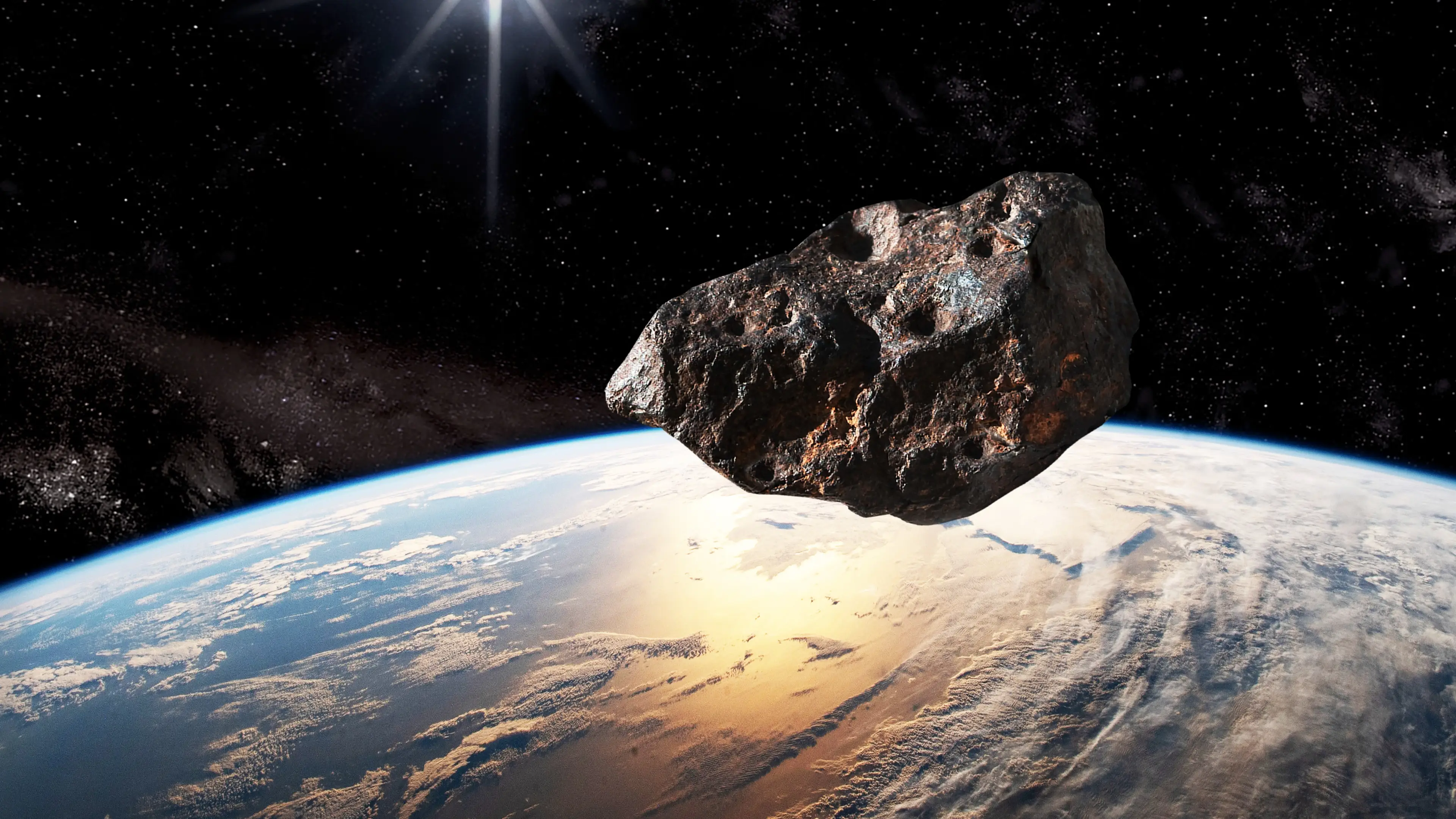
Giant asteroid 2026 JH2 to get closer to Earth than the moon tonight and you can watch it

A huge, newly-discovered asteroid will pass ‘unusually close’ by Earth tonight, after it was discovered last week by astronomers in Arizona.
The space rock has been named 2026 JH2 and, according to the BBC, is around 35 metres wide, the length of a 5-a-side football pitch.
It’s due to fly by the Earth on Monday (18 May) evening at roughly 10pm BST (5PM EDT), coming within 91,000 kilometres of our planet.
For context, that’s closer, less than a quarter of the distance, to the Moon and some satellites.
Advert
But, before we all start panicking about the end of the world, let me reassure you that astronomers say there's no danger that asteroid 2026 JH2 will hit Earth.
However, scientists and space lovers alike are excited as the close proximity will allow for observation with telescopes and binoculars.
It’s also an extremely rare event, as the asteroid isn’t expected to be near Earth again in 2060, so you’ll need to cancel your Monday night plans if you fancy getting a glimpse of the astrological moment.
If you don’t own a telescope or other equipment to help you observe it, the Virtual Telescope Project is planning to broadcast a live stream of the flyby starting at 8:45pm BST.
However, Sky at Night Magazine has warned that it may be tricky to see because it will be low in the sky after sunset.
Virtual Telescope Project founder Gianluca Masi told Space.com: “At the time of the observation, the object will be moving pretty fast against the stars, but our advanced telescopes will precisely track 2026 JH2 while it will be almost at its minimum distance from us, peaking in brightness, around magnitude 11.5, before it will set below our horizon.”
In case you're unfamiliar, asteroids are small, rocky objects that orbit the Sun and are much smaller than planets.
The Italian astronomer added, “We will see it like a sharp dot of light, moving against the starry background, with stars leaving long streaks, as we will be tracking the asteroid.”
The company is hoping to catch sight of it with their telescopes in Manciano, Italy.
After that, as reported by the publication, the rock is expected to head on a 3.8-year round trip close the orbit of Jupiter before and back towards the sun, according to the European Space Agency.
2026 JH2 was first spotted last week by the Mount Lemmon Survey, which is an astronomical project based at the Mount Lemmon Observatory in Arizona.
Topics: Space, Science, Astrology, News, World News, UK News
 Madison Burgess