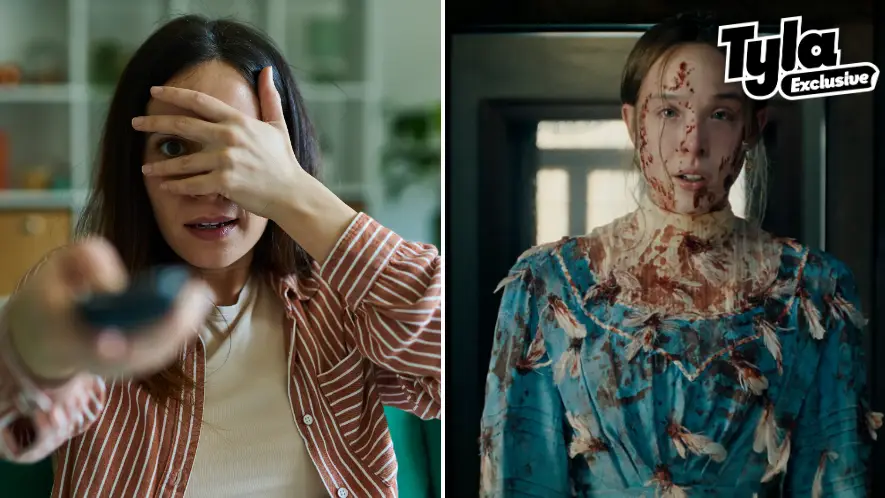
The dark psychology behind women's obsession with true crime

From serial killer documentaries to pulse-raising podcasts, millions of women can't seem to look away when it comes to true crime.
But experts say there could be a much darker, more practical, reason behind this pattern - and it's not because we're fascinated by murder.
If you've ever found yourself saying, 'I'll just watch one episode', before accidentally spending three hours learning everything there is to know about a murder you've never heard of before, you're certainly not alone.
True crime has become a seemingly unavoidable part of our entertainment diet.
Advert
There are the Netflix documentaries, the endless podcasts, the dramatised recreations, the interrogation footage, the serial killer interviews - and, of course, the increasingly niche corners of the internet dedicated to dissecting every clue, red flag and suspicious text message.
And while true crime fans certainly aren't exclusively women, research and audience studies have repeatedly suggested that women make up a particularly large proportion of the genre's audience.
Are we really just fascinated by murder?
According to forensic psychologist Dr Kerry Daynes, the answer could be considerably more complicated and unexpectedly rooted in self-preservation.
"Women showed a stronger preference than men for true-crime content, and that held specifically for stories involving female victims, survival strategies, and psychological insight into the perpetrator," she exclusively told Tyla. "Not gore or violence for its own sake."
In other words, that three-hour deep dive into a serial killer's childhood might not simply be morbid curiosity.
It could be your brain asking itself, 'How did this happen?', and 'How could I stop it happening to me?'.
Daynes believes one possible explanation is something known as 'prepared learning'.
The theory - which is rooted in evolutionary psychology - suggests that because women are more likely to experience certain forms of violence, including sexual assault and intimate partner violence, consuming stories about these crimes could act as a kind of rehearsal.
I know what you're thinking. It's not exactly the most relaxing bedtime activity, but potentially quite a useful one.
Documentary deep-dives and TV recreations can expose viewers to warning signs, dangerous situations, controlling behaviour and potential escape strategies, all from the safety of their own sofa.
"It's self-protection rather than pure fascination that drives female true crime fans," Daynes continued, emphasising, however, that this is a theory rather than proof that watching a Netflix documentary will somehow make you safer in real life.
The logic is pretty sound, though.
You watch a story about a woman who ignored a seemingly small red flag, hear about a controlling partner whose behaviour gradually escalated, learn how a victim was targeted, isolated or manipulated.
And suddenly, the terrifyingly unpredictable starts to feel slightly more predictable.
"Understanding why someone did something seemingly monstrous restores a sense of predictability," Daynes went on. "If we can identify the warning signs - childhood trauma, specific personality traits, situational triggers - the world becomes navigable again, and by extension, avoidable."
That's potentially where our obsession with the mind of the killer comes in, because it's one thing to know what someone did, but something else entirely to want to know why.

Or is it the killers themselves?
There's something particularly compelling about trying to get inside the head of somebody who has committed an act that feels completely incomprehensible.
How could they do it? What were they thinking? Did they know what they were doing? Were there warning signs? Could anyone have spotted them?
Psychotherapist Eloise Skinner believes the extreme nature of true crime can itself make us want to investigate the psychology behind it.
"We might think, for example, that we could never imagine ourselves doing something similar, and this might compel us to investigate why someone might end up acting in this way," she tells Tyla.
And there could be another psychological factor at play, with research from the University of Cambridge - involving more than 300,000 people across 57 countries - finding that women, on average, performed better than men on a widely used 'theory of mind' test.

This looks at the ability to infer what another person is thinking or feeling.
Skinner suggests this could potentially help explain why some women are drawn towards trying to understand the motivations of criminals.
In a true crime documentary, you're not simply being told that someone committed a terrible act.
You're being invited to reconstruct their world, relationships, childhood, personality, hardships and - arguably most importantly, the moment that something switched inside their head.
Do we resonate with the victims?
A story about a woman being followed home, manipulated by a partner or attacked by a stranger can feel horribly personal to female viewers because the victim can look, sound or live a life that feels familiar.
She might be the same age, live in the same kind of neighbourhood, use dating apps, have a boyfriend, enjoy a night out, and believe she's safe.
Daynes says that when a woman is targeted, particularly when we're given details about her life before the crime, viewers can imaginatively 'test-run' that vulnerability from a safe distance.
So, women are experiencing the fear without actually being in danger, right? Apparently so.
When you're able to pick up the clues yourself and follow the investigation, consumers eventually receive their answer.
And suddenly, a crime that began as something chaotic and terrifying has been turned into a narrative with a beginning, middle and end.
"That's why it can be a way of processing background anxiety about safety without having to actually be in danger," Daynes noted, adding that there's still a caveat to consider.
"It is surprising how many former victims watch true crime," she adds. "I think you can definitely have too much of it."
Is it only male killers we're intrigued by?
This brings us to one of the biggest true crime obsessions of all: female murderers.
Netflix's latest Monster instalment, Monster: The Lizzie Borden Story, puts a woman accused of one of America's most notorious double murders at the centre of the story.
The series, created by Ryan Murphy and Ian Brennan, dramatises the 1892 murders of Lizzie Borden's father and stepmother - crimes for which Borden was eventually acquitted.
As a female true crime fanatic myself, I admit - there's something about a female killer that still makes me sit up and ask, 'But, how could she?'.
Daynes believes part of the fascination comes down to how dramatically female violence clashes with the traditional image of women as caregivers.

"Women committing lethal violence, especially against family, cuts against the deep cultural script of women as caregivers and non-aggressors," she told us. "It registers as a bigger departure from our cultural norms which makes it more 'monstrous' and more compelling as a story."
That makes Lizzie Borden a particularly mesmerising figure for fans of the macabre.
She wasn't just a murder suspect - she became an enduring cultural mystery because the idea of a seemingly respectable woman brutally killing her own family challenged the expectations of what women were supposed to be.
Netflix's new series leans heavily into that tension, exploring Borden against the backdrop of a Victorian household and the social restrictions placed on women at the time.
And the fascination hasn't gone away. In fact, over 130 years later, we're still asking whether she did it.
Isn't that a strange double-standard?

There's one thing we can say with a large degree of certainty - male violence against women is a tragically familiar tale.
Meanwhile, female violence of any kind can feel like a violation of the role society has historically expected women to play.
Daynes says female killers can consequently be viewed in two contrasting ways - either as especially monstrous because they've broken that cultural script, or as more understandable because audiences search for an explanation that makes their behaviour fit within familiar categories, like provocation, mental illness or victimhood.
And that may be why stories about women - such as Lizzie Borden's - continue to generate such intense discussion, because we're not just asking whether they committed a crime, but what their crime says about womanhood itself.
Why do women like to play detective?
From reverse-image searching a dating-app match to investigating someone's social media before meeting them, the internet has made it easier than ever to scrutinise the person behind the profile.
Writing in The Guardian a while back, journalist Nancy Jo Sales argued that the explosion of true crime and the rise of online dating may be more connected than they initially appear.
Sales pointed to the fact that women increasingly meet strangers online, creating a more significant need to assess whether somebody is safe before meeting them in person.
Essentially, it's the same instinct playing out in two different places - who is this person? What are they hiding? What red flag am I missing?
And true crime simply gives us the most extreme possible version of those questions.

Once you've spent enough time hearing how seemingly ordinary people can conceal extraordinary secrets, it's perhaps not surprising that you start looking twice at the people around you.
So, is our obsession actually about fear?
For a while now, the stereotype has been that women watch murder documentaries because they're fascinated by blood, gore and serial killers.
But the psychology experts suggest the reality can be far more complicated, and that this particular genre of entertainment actually offers us a strange combination of fear, education, identification, empathy, pattern recognition and control.
It teaches us what danger can look like, gives us the language for behaviours we might otherwise dismiss, and allows us to imagine ourselves in frightening situations without actually being in them.
In this way, it can satisfy one of our most basic psychological urges - to understand something terrifying well enough that it doesn't feel quite so unpredictable anymore.
Topics: Crime, True Crime, Documentaries, Entertainment, Netflix
 Rhianna Benson