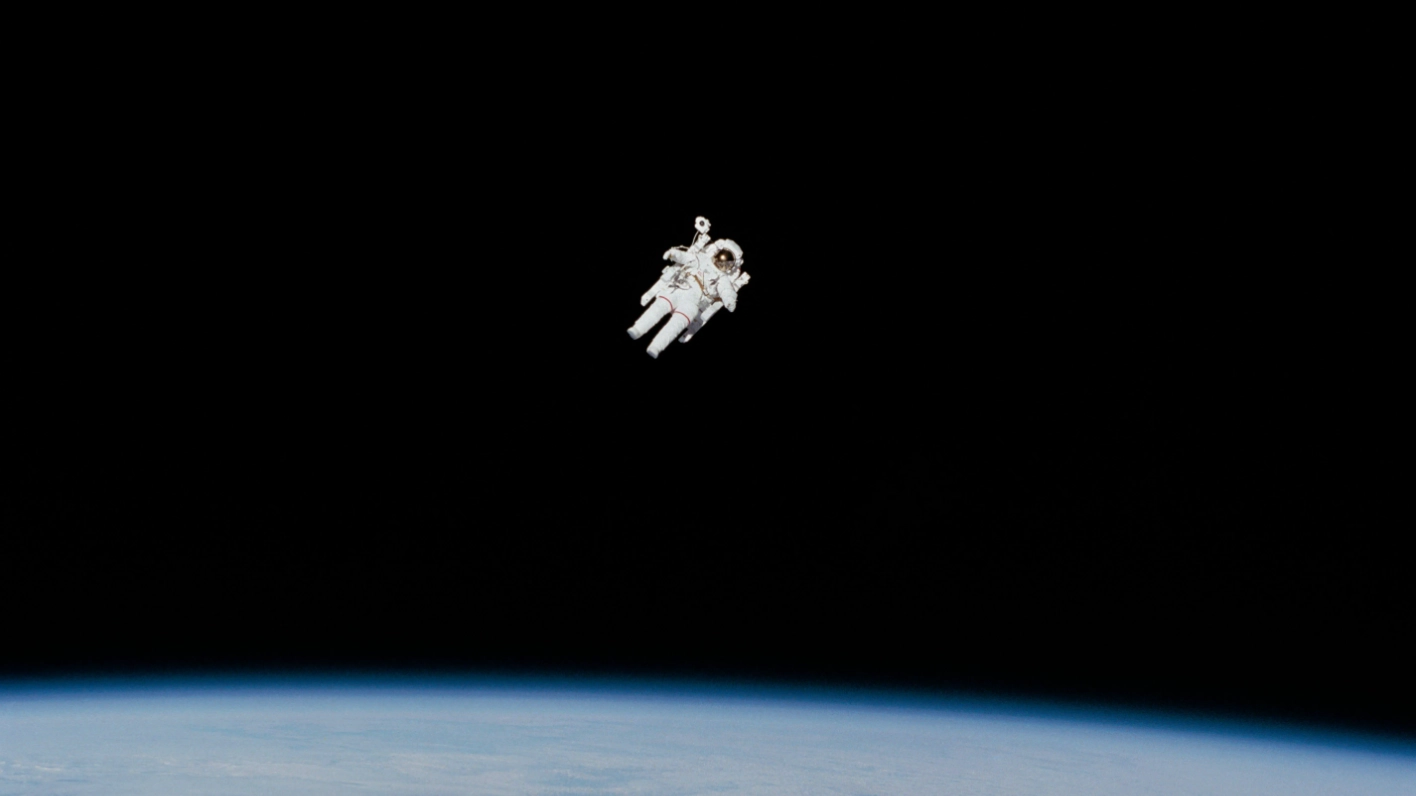
Unbelievable story behind the ‘most terrifying’ image NASA has ever taken

When you think about it, it's pretty mad what astronauts have been able to achieve ever since Neil Armstrong went to the Moon taking 'one small step for man, one giant leap for mankind' on July 20, 1969 during the Apollo 11 mission.
Just 15 years later, astronaut Bruce McCandless II performed the first-ever untethered spacewalk and it paved the way for some of the 'most terrifying' images NASA has ever taken.
Back on Feb 7, 1984, McCandless approached his maximum distance from the Earth-orbiting Space Shuttle Challenger, which saw him totally untethered in the vast cosmos - a first in history.
Advert
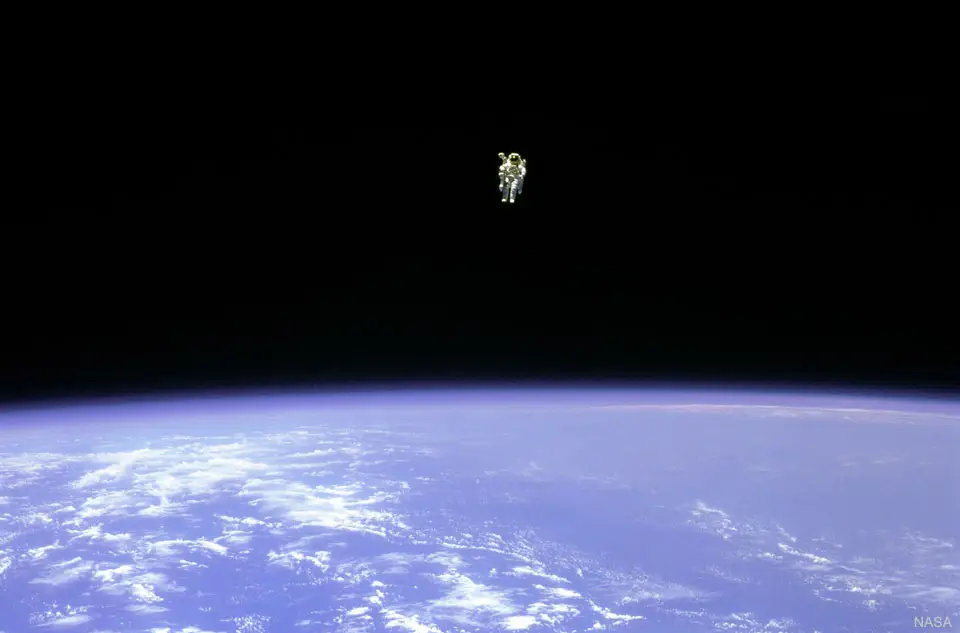
As he was testing out the nitrogen-propelled, hand-controlled back-pack device called the manned maneuvering unit (MMU) for the first time, McCandless' fellow crew members aboard the reusable vehicle photographed him in what would go on to become one of the coolest snaps ever papped.
At 7:25 on Tuesday morning, Houston time, McCandless fired up his jetpack and rose slowly from Challenger’s cargo bay and flew clear of the spacecraft.
Despite running through his flight checklist and all his years of training, his palms bursted with sweat.
"It may have been a small step for Neil," he said, "but it’s a heck of a big leap for me."
Moving backward at no more than a foot a second, in order to preserve valuable fuel, McCandless watched as the chasm separating him from Challenger steadily expanded.
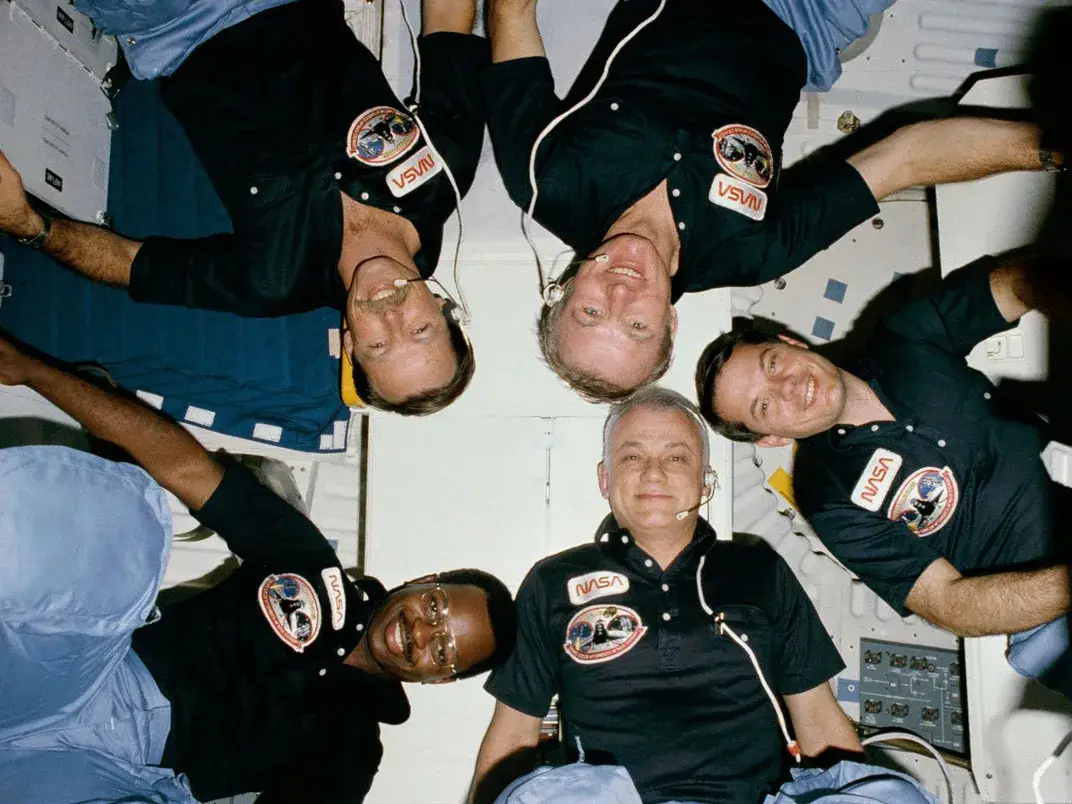
While he was completely untethered, fellow astronaut Ronald E. McNair, stood inside the cabin by the controls of the shuttle’s robot arm, ready to snatch McCandless to safety if necessary.
Still looking back at the shuttle, McCandless at last reached his destination and brought the jetpack’s progress to a halt - around 320 feet out in space at a staggering 170 miles above the Atlantic ocean.
However, despite traveling at 23 times the speed of sound, he felt no sense of movement until he looked down and saw the planet rotating beneath his feet.
"Looks like Florida. It is Florida!" he said as he spotted Cape Canaveral below. "It really is beautiful."
Looking out from the cockpit, pilot Robert L. 'Hoot' Gibson centred McCandless in the viewfinder of his Hasselblad camera.
He then pulled the 70mm camera away from his eye, briefly startled by the sheer grandeur and clarity of the image he had framed - McCandless in his seemingly glowing white space suit suspended alone in the darkness of space, while Earth curved beneath him.
Gibson checked the settings on the camera and then did so again, pointed the lens through the triple-paned cabin window and made sure to tilt it to level the horizon.
He then pressed the shutter.
And the rest was history.
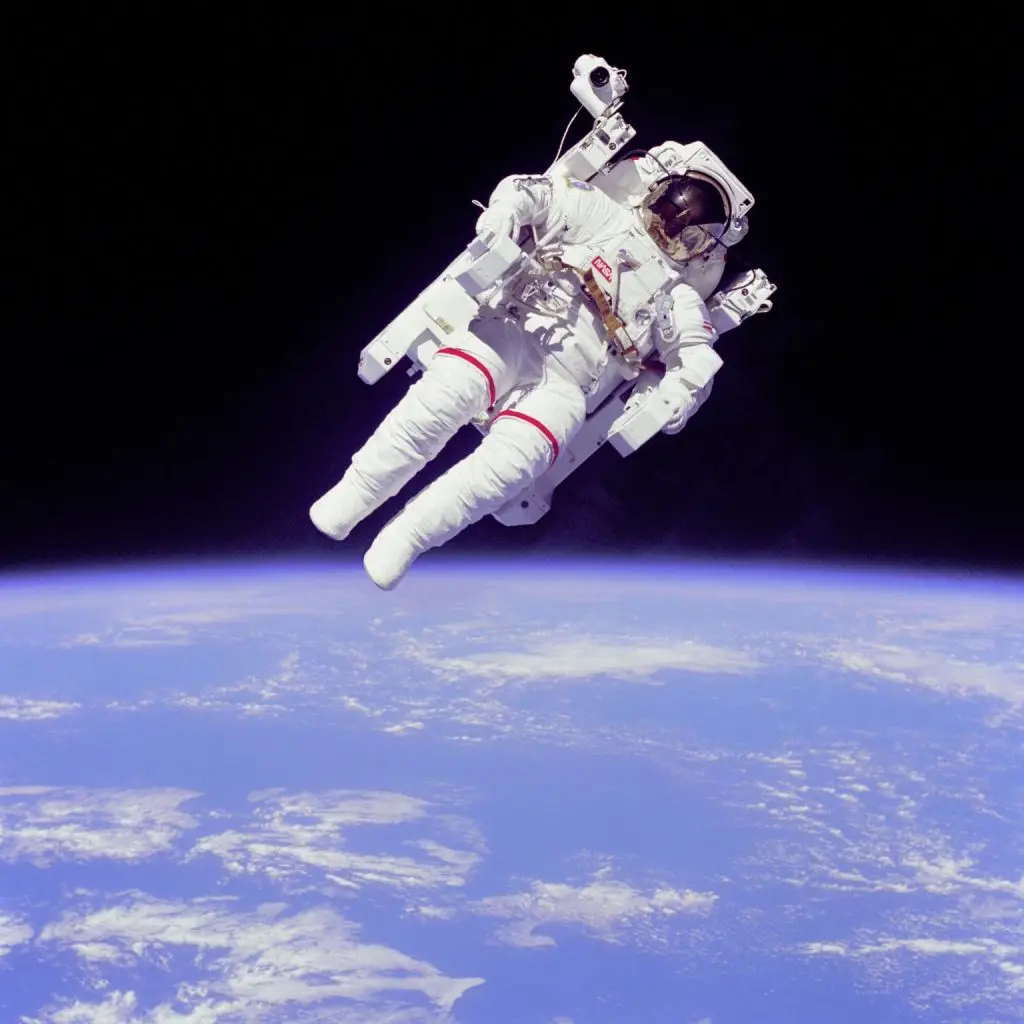
In a 2020 'Astronomy Picture of the Day' post, NASA wrote: "At about 100 meters from the cargo bay of the space shuttle Challenger, Bruce McCandless II was living the dream -- floating farther out than anyone had ever been before.
"Guided by a Manned Maneuvering Unit (MMU), astronaut McCandless, pictured, was floating free in space. McCandless and fellow NASA astronaut Robert Stewart were the first to experience such an 'untethered space walk' during Space Shuttle mission 41-B in 1984.
"The MMU worked by shooting jets of nitrogen and was used to help deploy and retrieve satellites. With a mass over 140 kilograms, an MMU is heavy on Earth, but, like everything, is weightless when drifting in orbit. The MMU was later replaced with the SAFER backpack propulsion unit."
After seeing the snap, which is now over four decades old, it's clear people couldn't wait to share their reactions with one Instagram user exclaiming: "Floating in space, HARDSTYLE!"
"Wtf I didn't know this was real??" admitted a second, while a third piped up: "Absolutely not! So scary!"
A fourth chimed in: "That’s wild."
"This gives the me same anxiety as deep sea photos," confessed a fifth.
A sixth gushed: "He’s actually on the of the world."
"Insane… I couldn’t do it. But the images are wicked," echoed another.
And a final Instagram user praised: "Floating untethered in space a true astronaut’s leap..."
It sure is!
 Rhiannon Ingle