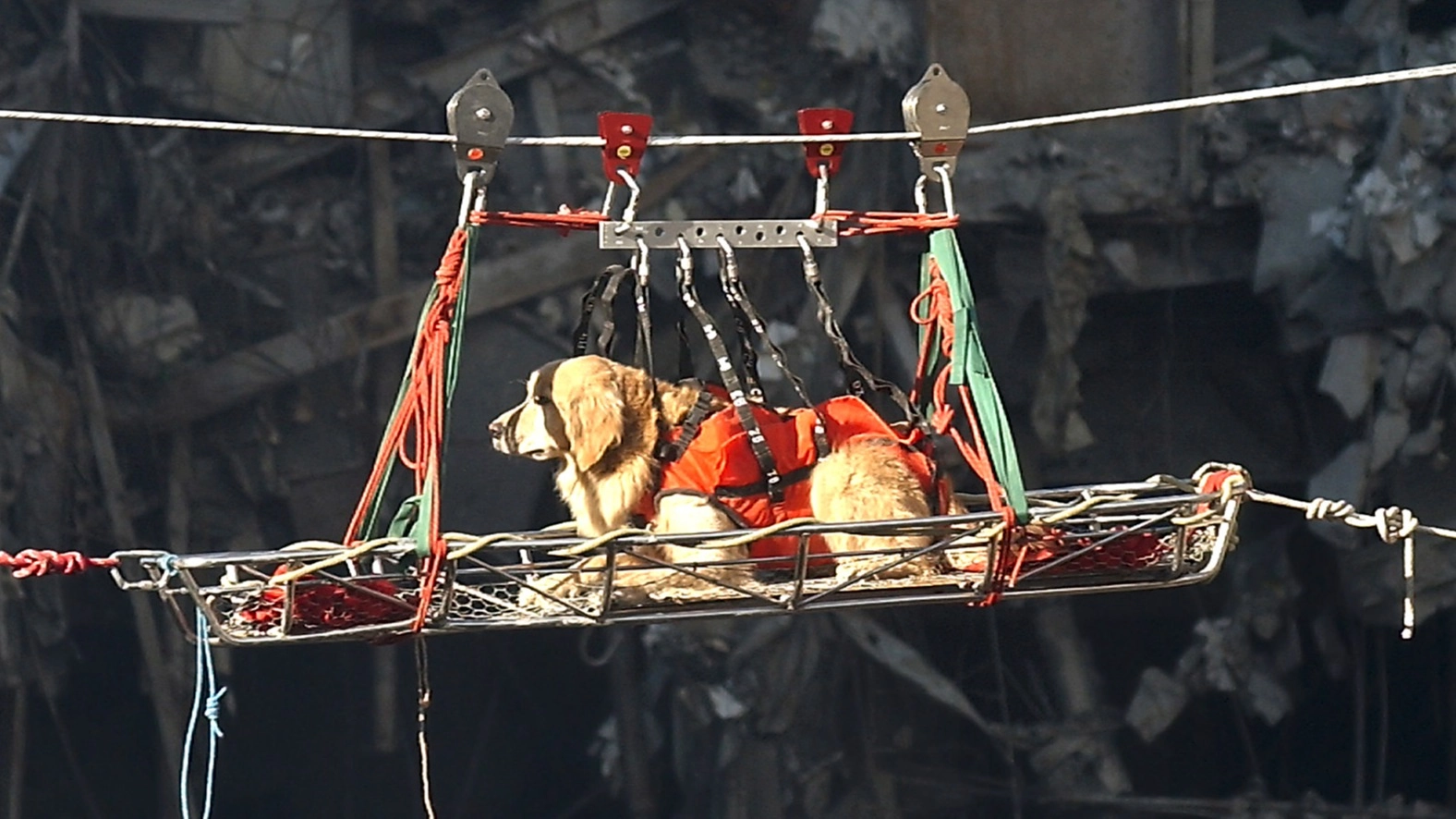
Heartbreaking impact 9/11 had on search-and-rescue dogs as they struggled to locate victims

Some of the most enduring images of the 9/11 aftermath, 25 years on, are of search-and-rescue dogs climbing across the ruins of the World Trade Centre, desperately seeking survivors.
More than 300 specially trained dogs were deployed to Ground Zero in the days, weeks and months following the attacks.
Their task was simple in theory, to use their extraordinary sense of smell to locate people trapped beneath the rubble.
But as the hours after the attack turned into days, the mission changed as the chance of finding survivors dwindled.
Advert
The dogs were left searching an immense and dangerous debris field for victims who were no longer alive, and many of them started to struggle.
Christine Famiglietti was an NYPD officer who helped during the Ground Zero clean-up effort.

She shared her memories of helping the distressed dogs, who were starting to show signs of depression after failing to find anyone alive.
Yahoo reports: "They asked for volunteers to hide in the rubble. They pulled everyone off the rubble and hid a bunch of us, and they told us to lie down like we were hurt.”
She recalled: “They then sent all the dogs in, and the dogs started barking, and life came back; everyone was clapping. Life came back to the place, and we pretended they had found us, and it was incredible; it was something that was unbelievable, moving – it really was."
Dr Cynthia Otto, a veterinarian who travelled from Pennsylvania to New York after the attacks and later led a long-term study of the dogs, recalled how difficult that transition was.
“That was just the most devastating part of the whole process,” Otto told ABC News.
“All of these dogs were trained to find live humans, but it became clear that they started to recognise human remains, and they didn't do their normal response.”
Search-and-rescue dogs are trained to detect the scent of living people and are rewarded for making a successful find.
As the operation shifted towards recovery, handlers were asking animals trained for rescue to work in circumstances where there were increasingly few lives left to save.
Denise Corliss, who travelled to New York with her two-year-old Golden Retriever Bretagne as part of Texas Task Force 1, described the change to Voice Of America: “Toward the end of our mission, it changed from a search mission to a recovery mission.”

The physical conditions were punishing, too, and the dogs worked for hours across unstable piles of concrete and twisted steel, amid smoke, ash and dust.
Some were lowered into spaces too small for human rescuers to enter.
Others suffered cuts, burned paws, exhaustion, dehydration and respiratory irritation.
One study of 27 New York Police Department dogs found that 17 experienced a health disorder during the first week of deployment, although the conditions were generally short-lived.
Yet the long-term story of the dogs is not one of widespread illness.
Research following 95 dogs deployed to the World Trade Centre, found their median age at death was 12.8 years, compared with 12.7 years among 55 non-deployed search dogs.
Scientists found no significant difference in cause of death between the groups, despite finding lung particulates much more often in the exposed dogs.
Bretagne was the last surviving search dog from the 9/11 response before she died in 2016 aged 16.
By then, she had become more than a symbol of the rescue effort.
She had gone on to work at other disasters and later served as a reading-assistance dog.
The dogs entered the wreckage, searched where humans could not and worked alongside rescuers confronting unimaginable loss.
For those who handled them, that presence mattered.
As Otto put it, the dogs ‘provided some sort of source of comfort for all of us that were working there’.
 Jen Thomas