
Woman stole $4,500,000 before mysteriously vanishing - and authorities still can't find her

In 2014, Oxford University graduate Ruja Ignatova defrauded numerous investors into donating billions to her cryptocurrency firm, OneCoin.
Three years later, however, the Bulgarian businesswoman's financial ploy was exposed by global investigators who'd been hot on her trail for some time.
In October 2017, Ignatova boarded a Ryanair flight to Athens from Sofia, never to be seen again. To this day, international authorities are none the wiser as to her whereabouts.
Some investigators believe her affiliation with organised crime and notorious mobsters might explain her sudden disappearance, whilst others are convinced she's simply living peacefully with a brand new identity and possibly extreme surgical changes.
Advert
Either way, for almost a decade now, Ignatova's name has sat comfortably on the FBI’s Ten Most Wanted list.
Here's everything we know about her astonishing case.

Who is Ruja Ignatova?
Born in Ruse, Bulgaria, to a mechanical engineer father and a nursery school teacher mother, Ignatova moved from her home country to Germany in 1990.
According to the 2022 biography, The Missing Cryptoqueen: The Billion Dollar Cryptocurrency Con and the Woman Who Got Away with It, she'd written in her schoolbook: "OK, fine. Maybe I did take pleasure in tormenting some students. I was always looking for the chance to spread new amusing stories about them."
Following her scholarship to the University of Konstanz at the age of 18, she graduated with a PhD in private international law.
Ignatova later underwent a Master's degree at Oxford University, where she studied European law, before returning to Bulgaria and dividing her time between the country's capital, Sofia, and Germany.

How did she get into crypto?
Despite forging a successful career in finance, by 2014, Ignatova had become intrigued by the sudden surge in interest in cryptocurrency.
That year, she launched her own cryptocurrency, OneCoin, after reportedly being inspired by the popularity of Bitcoin.
Speaking to potential investors, Ignatova claimed her business was simple, yet safe, insisting that they only needed to send money to a nondescript bank account to become a part of the programme.
Within a year, the scam skyrocketed in popularity, with wealthy investors pouring billions in from across Europe, as well as from the US, Australia, Asia, and the Middle East, as a result of her false claims that the coin's value was increasing.

Where did it all go wrong?
According to reports from the BBC, by October 2017, Ignatova had caught wind that police were looking into her scheme, and instead of flying to Lisbon - where she was scheduled to appear at an investors conference - she flew to Athens.
And after stepping out of the airport, she disappeared into thin air. Two years later, her brother, Konstantin Ignatov, pled guilty to fraud and money laundering, having assisted his sister in her con.
Along with the issuance of an Interpol Red Notice, police in Germany launched investigations into her whereabouts, placing her on the country's 'most wanted' list for fraud charges.
Meanwhile, in 2024, a UK court ordered a global asset freeze on Ignatova's assets, preventing them from being moved or sold (via the BBC).
In America, she was added to the FBI's Ten Most Wanted Fugitives list, with a $5,000,000 reward offered for information on her whereabouts last year.
Bulgaria's Bureau of Investigative Reporting and Data (BIRD) had previously alleged that Krasmir Kamenov - a Bulgarian organised crime boss - had attempted to fund a US investigation into Ignatova's disappearance, but he had been killed before being able to assist the authorities.
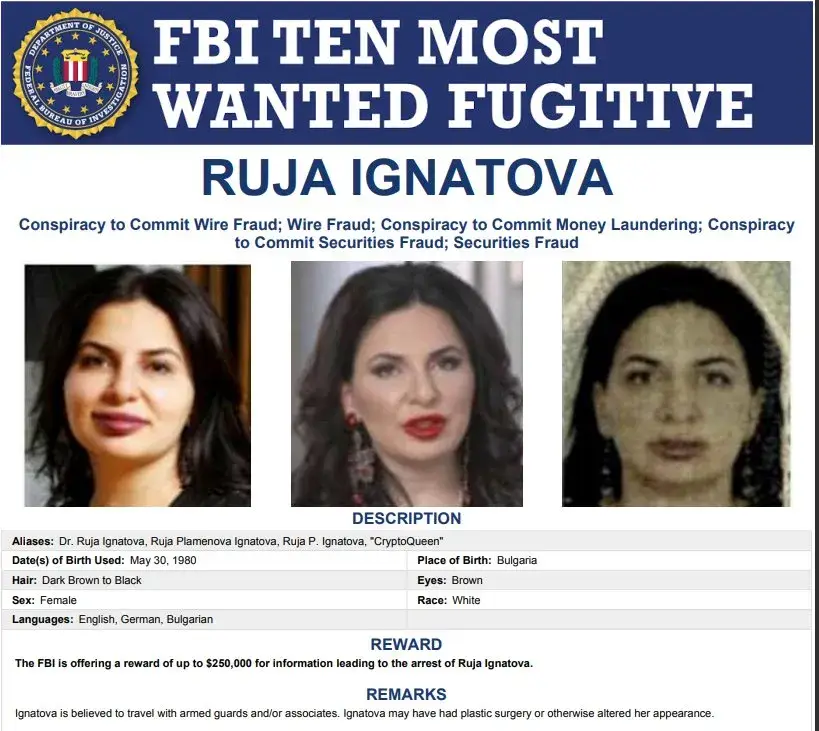
Where is she now?
In 2022, FBI Special Agent Paul Roberts said that America's authorities were 'operating under the assumption' that Ignatova 'is still alive'.
Despite this, a report from BIRD alleged that a police informant had told Bulgarian officers that the brother-in-law of an infamous drug lord known as 'Taki' Hristoforos Amanatidis had drunkenly claimed she'd been murdered on the latter's orders.
The man ordered by 'Taki' to kill her, Hristo Hristov, has been serving a sentence in a Dutch prison for drug trafficking for several years.
The report claimed that Hristov had murdered Ignatova on a yacht in the middle of the Ionian Sea, before dismembering her body and throwing the pieces out to sea.
The motive behind the alleged killing? To cover up 'Taki's' role in the cryptocurrency plot.
While this claim is currently unverifiable, former US Internal Revenue Service employee Richard Reinhardt told the BBC last year that he agreed with this theory, believing Ignatova had hired him to protect her, but that the deal had become dodgy.
"We were told, allegedly, a big-time drug guy was in charge of her physical security," he told the British broadcaster last year. "Taki came up more than once; it wasn’t like it was a one-off. That was a recurring theme."
These claims also coincided with information that US government lawyers had received, which described Ignatova's 'personal security guard' as a major organised crime figure, but didn't name him.
Leaked Europol documents also alleged that the two had established a relationship before her 2017 disappearance.
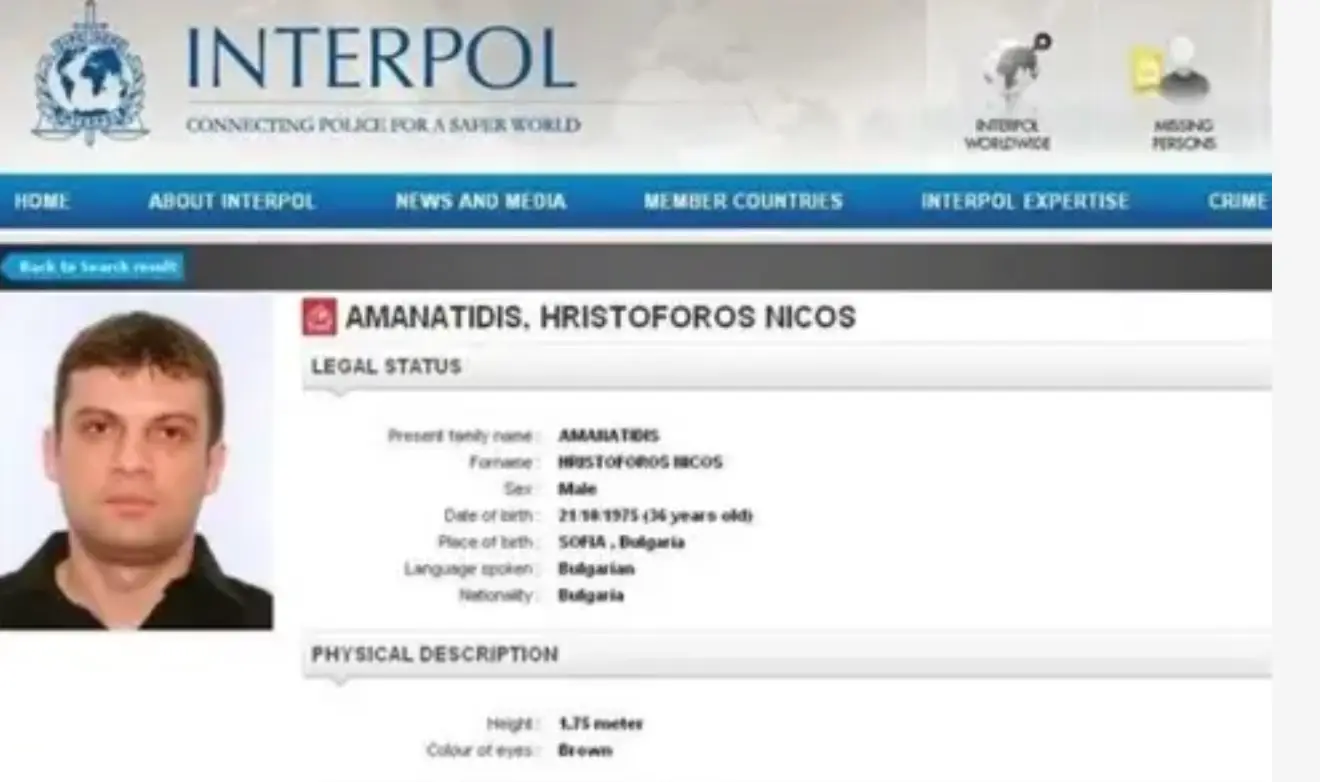
Ivan Hristanov, a former Bulgarian deputy minister, also told the broadcaster: "When we talk about Taki, he’s the head of the mafia in Bulgaria. He's extremely powerful. Taki is the ghost. You'll never see him. You only hear about him.
"He's talking to you through other people. If you don't listen, you just disappear from earth. The only person who can protect her [Ignatova] from all those investigations, including from foreign agencies - it was Taki."
In May 2023, Krasmir Kamenov was assassinated in his Cape Town home, along with his wife and two of his colleagues, with Hristanov believing he'd been written off by 'Taki's' associates over information about his assistance of Ignatova.
"Certain people had to be removed because they knew too much about Taki," he explained. "It was kind of a public execution that looked more like a statement. Be careful who you deal with."
Despite these claims, 'Taki' - who is believed to live in Dubai - has yet to face an arrest over the claims of Ignatova's alleged murder, as her body was never discovered, and police don't believe they have enough evidence to charge him.
The prosecutor's office in Sofia, Bulgaria, also told the BBC that it 'does not cover up crimes and persons who have possibly committed crimes'.
To this day, she remains a hunted woman.
Topics: True Crime, Crime, Real Life, True Life, Money, News
 Rhianna Benson