tyla homepage
  • News
  • Life
  • TV & Film
  • Beauty
  • Style
  • Home
  • News
    • Celebrity
    • Entertainment
    • Politics
    • Royal Family
  • Life
    • Animals
    • Food & Drink
    • Women's Health
    • Mental Health
    • Sex & Relationships
    • Travel
    • Real Life
  • TV & Film
    • True Crime
    • Documentaries
    • Netflix
    • BBC
    • ITV
    • Tyla Recommends
  • Beauty
    • Hair
    • Make-up
    • Skincare
  • Style
    • Home
    • Fashion
    • Shopping
  • Advertise
  • Terms
  • Privacy & Cookies
  • LADbible Group
  • LADbible
  • UNILAD
  • SPORTbible
  • GAMINGbible
  • UNILAD Tech
  • FOODbible
  • License Our Content
  • About Us & Contact
  • Jobs
  • Latest
  • Archive
  • Topics A-Z
  • Authors
Facebook
Instagram
X
Threads
TikTok
Submit Your Content
Scientist makes new claim about human 'bisexual range' and it might surprise you

Home> Life> Sex & Relationships

Published 17:08 25 Feb 2025 GMT

Scientist makes new claim about human 'bisexual range' and it might surprise you

Dr. Jason Hodgson - who works at Anglia Ruskin University in Cambridge - made a bold statement about bisexuality as part of a human spectrum

Rhianna Benson

Rhianna Benson

google discoverFollow us on Google Discover
Featured Image Credit: Getty Stock Images

Topics: LGBTQ, Life, Real Life, True Life, Science, Sex and Relationships

Rhianna Benson
Rhianna Benson

Rhianna is an Entertainment Journalist at LADbible Group, working across LADbible, UNILAD and Tyla. She has a Masters in News Journalism from the University of Salford and a Masters in Ancient History from the University of Edinburgh. She previously worked as a Celebrity Reporter for OK! and New Magazines, and as a TV Writer for Reach PLC.

X

@rhiannaBjourno

Advert

Advert

Advert

It's long been claimed that sexuality is a spectrum, but recently, one scientist has taken this notion one step further by making a bold claim that almost all of us are bisexual.

For those in need of a reminder, individuals that traditionally identify as 'bisexual' feel a sexual attraction to both men and women, as opposed to a single sex.

According to a 2021 survey by the Office of National Statistics, 1.3% of people aged 16 living across England and Wales identified as bisexual - equating to around 624,000 people.

As we say, however, as studies into sexuality develop as part of ever-changing societal norms and acceptances, one evolutionary geneticist has recently spoken out about misconceptions of bisexuality.

Advert
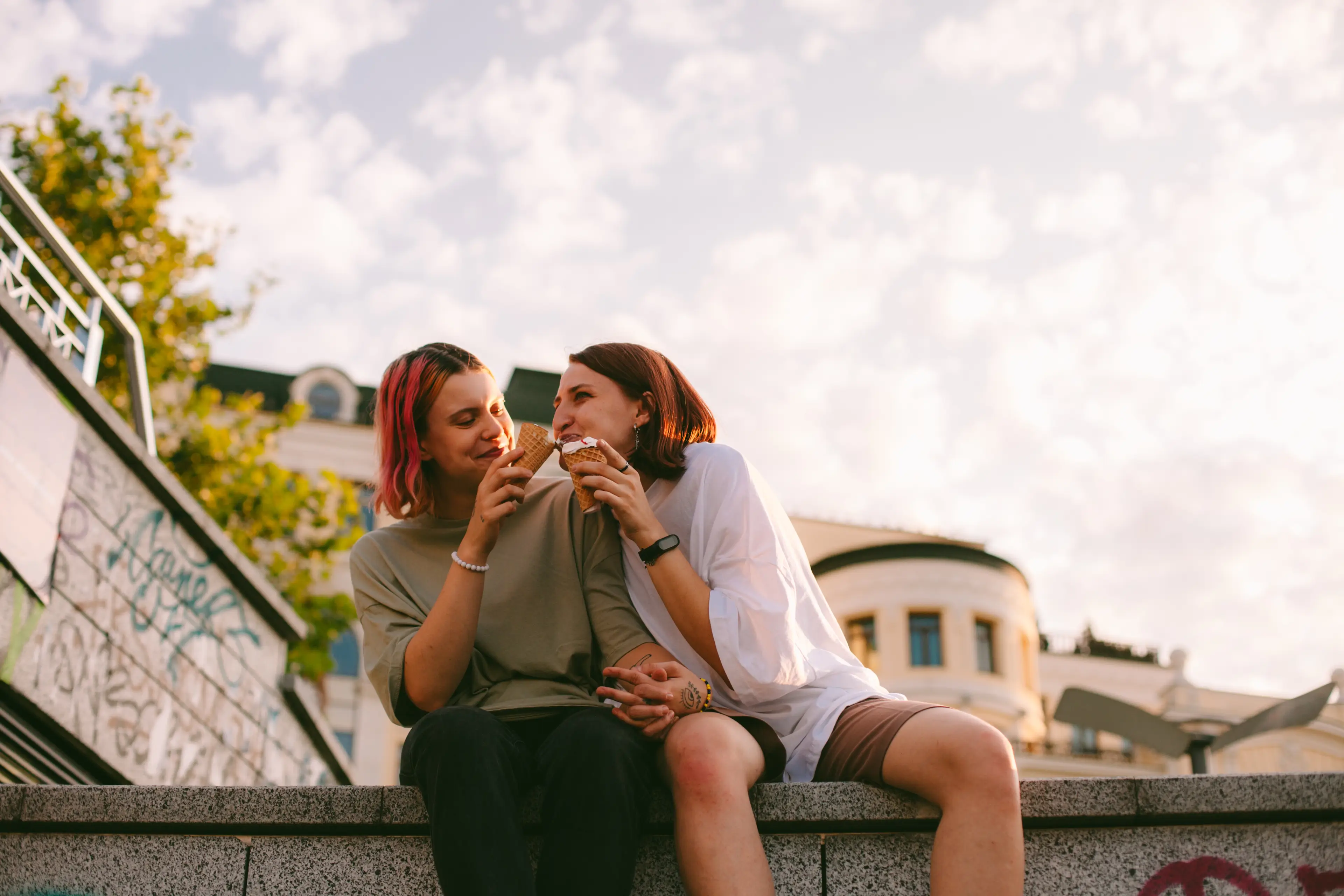
The anthropologist believes no one is either 100 per cent gay, or 100 per cent 'straight' (	Dmytro Betsenko/Getty)
The anthropologist believes no one is either 100 per cent gay, or 100 per cent 'straight' ( Dmytro Betsenko/Getty)

In fact, he declared that this specific way of identifying oneself could be even more omnipresent than many scientists first thought.

Speaking to the Daily Mail, Dr. Jason Hodgson - who works at Anglia Ruskin University in Cambridge - opened up about his recent search on the 'bisexual range' of humans.

He believes, that people are rarely 100 per cent heterosexual, or 100 per cent homosexual.

Instead, Dr. Hodgson believes, in the case of human beings, that sexuality sits on a spectrum, and that 'most people should actually be bisexual'.

"The genes that influence same-sex sexual behaviour are probably just genes that influence general sociality," he told the publication.

"And people in the middle of the range of variation are probably better at all social relationships."

Dr. Hodgson continued: "Therefore people who would engage in same-sex sexual behaviour in some situations are probably also better at forming heterosexual relationships."

He added that such was also the case in relationships between the majority of primates, adding that bisexuality plays a social role in several animal groups.

Dr. Hodgson said the same pattern is visible in some animals (Klaus Vedfelt/Getty)

A 2016 study that Dr. Hodgson conducted found that bonobos, in particular, are one of the few species that regularly engage in same-sex interactions - more so than with opposite-sex.

Illustrating his point in humans, the scientist uses numbers, and he believes every human has a 0-1 range, with the former representing heterosexuality and the latter indicating pure homosexuality.

He added: "So, if a person had one homosexual experience and 99 heterosexual experiences their value would be 1/100 or 0.01 — just slightly in the bisexual range."

Dr. Hodgson made sure to note that, by sexual 'experiences', this itself could range from a physical encounter with another person, or simply arousal.

With that in mind, he adds that an individual doesn't necessarily have to engage in either traditional heterosexual and homosexual acts to constitute as 'bisexual'.

"I suspect most people would be slightly in the bisexual range if given the right social circumstances," he concluded.

Choose your content:

a day ago
  • Getty Stock Image
    a day ago

    Early warning signs of cervical cancer after Nicole ‘Snooki’ Polizzi gives heartbreaking update on diagnosis

    The Jersey Shore icon has opened up two months after revealing she had the disease

    Life
  • Getty Stock Image
    a day ago

    Common household medicine could help reduce risk of cancer

    The everyday painkiller is thought to prevent certain tumours from forming and spreading across the body

    Life
  • Getty Stock Image
    a day ago

    Unexpected reason your antihistamines aren’t working

    A doctor has revealed what could be 'reducing the effectiveness' of your antihistamines as the pollen count is on the rise in the UK

    Life
  • Getty Stock Image
    a day ago

    Cancer is now diagnosed every 80 seconds as one type hits record high in young people

    Experts have cited certain lifestyle factors for the uptick in cases

    Life
  • 'Cinderella rule' explained as people swear strict habit has improved sex life
  • Neuroscientist reveals how to get over 'limerence' attachment
  • Erectile dysfunction is affecting more young men than ever - here's why
  • Your partner might be 'dry begging' you without you even noticing