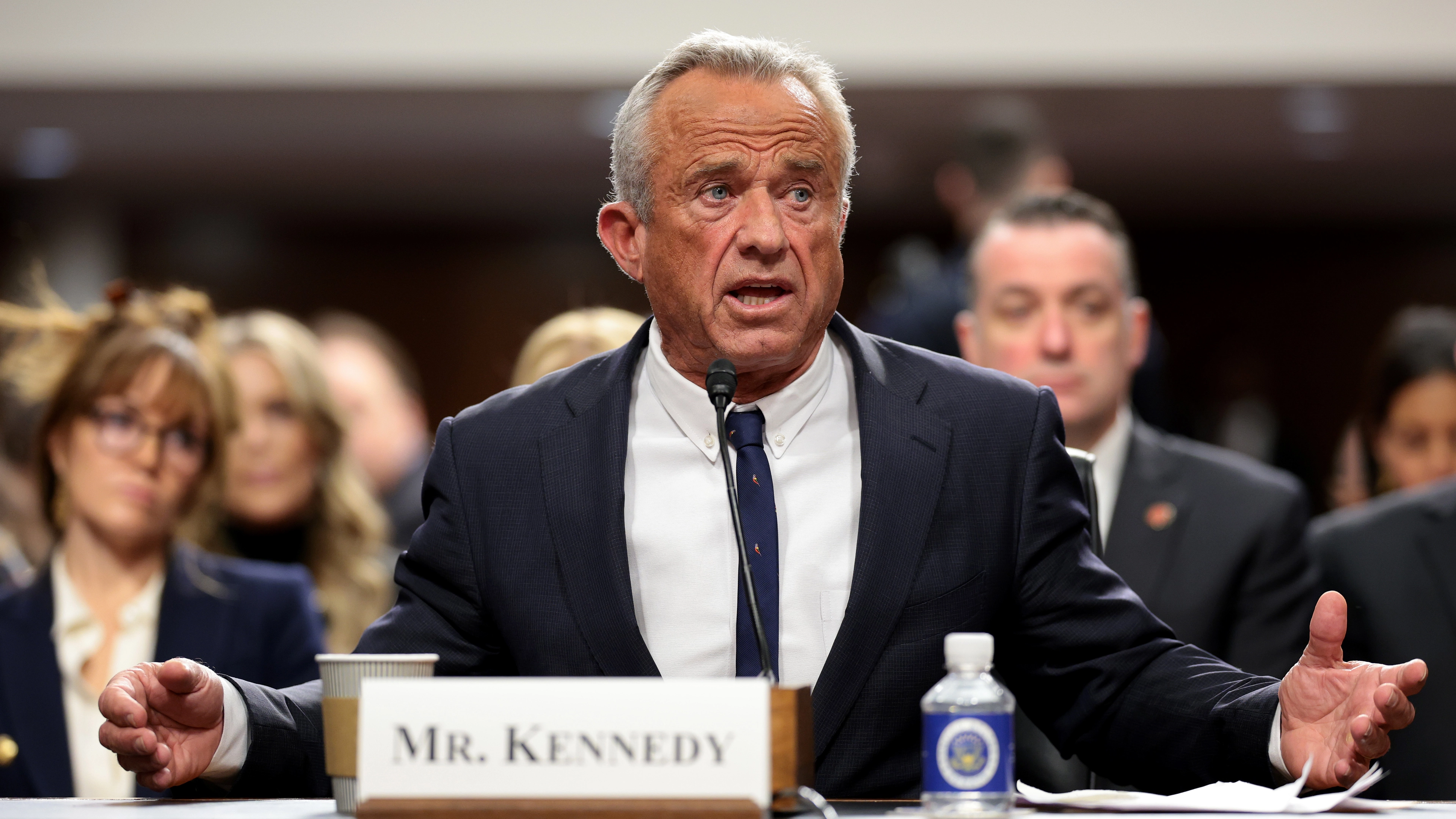
Real reason RFK Jr.’s voice is raspy as he’s heard in court

Now that Donald Trump has taken to office for his second term, his pick to lead the US Department of Health and Human Services, Robert F. Kennedy Jr., is getting a lot of attention for his voice.
It's been two weeks since the president's inauguration, which saw him waste absolutely no time by signing over 20 executive orders on that very day.
However, he has has since continued to push through more and more things to change.
Advert
One of those things is putting Robert F. Kennedy Jr. in the role to lead the US Department of Health and Human Services.
This has meant that Kennedy - who is the nephew of the late president John F. Kennedy - has been seen more and more when it comes to official talks and speeches in US politics, leading to people to realise that there is something different about his voice.
Specifically, that it’s a very raspy voice.
When he was talking during his confirmation hearing on Wednesday, 29 January, his voice was in full force. However, what many might not know is that the 71-year-old has suffered from a rare neurological condition for decades.
Spasmodic dysphonia is a voice disorder, which affects certain muscles in the voice box.

Essentially, it causes them to spasm, which can lead to a strained or raspy tone.
Kennedy has always been open about his condition and has been talking about this since the 90s.
He said in 2004 when appearing on The Diane Rehm Show: "I have a tremble in my voice … particularly when I first start talking."
He explained that his condition meant that he once went from being able to address 'large halls without any amplification' to having a tremor in his voice which causes him to sound raspy.
"At that time, I was making a lot of my income doing public speaking, and I could speak to large halls without any amplification," Kennedy said in an interview while running for president in 2024, before ultimately suspending his bid and endorsing Trump.
"When I was 42 years old, I got struck with a disease, a neurological disease, an injury called spasmodic dysphonia, and it makes my voice tremble."

He added: "I think it makes it problematic for people to listen to me. I cannot listen to myself on TV."
While he has tried Botox injections on his vocal cords, there is no known cure.
"It doesn’t treat the disorder; it treats their phenomena," Dr Andrew Blitzer, an otolaryngologist at Mount Sinai in New York City, told CNN. "We can’t change the brain signal coming in to the muscle, but we can weaken the muscle so it can’t go into spasm."
The disorder is usually found in more women than men, but may affect up to around 500,000 people across the US.
Researchers aren’t sure what causes spasmodic dysphonia, but they have found that middle-aged people are more at risk of developing it.
"A small number of people, maybe 5%, will find that it goes away just like it came, and we don’t really know why," neurologist Dr Hyder Jinnah told CNN.
"Most people have it for most of their life once it starts, and so we have to figure out ways to treat it."
Topics: Donald Trump, Politics, US News, Health
 Britt Jones