Anyone who eats eggs issued warning following deadly Salmonella outbreak

One person has died, and hundreds have fallen ill in the UK following a Salmonella outbreak that’s been linked to eggs.
The UK Health Security Agency (UKHSA) has issued a warning that the food poisoning surge may be linked to eggs imported from outside the country.
It confirmed there has been one death associated with the outbreak, while the Food Standards Agency (FSA) assured that there is ‘no evidence that UK-produced eggs are affected’.
It instead outlined that investigations had identified links to imported eggs that are ‘mainly used by food service and catering establishments such as restaurants or cafes, as a potential source’.
Advert
As of 13 August 2026, the UKHSA reported 207 confirmed cases between 11 August 2025 and 1 August 2026, all of which indicate a common source of contamination. All but one of the cases - 206 out of the 207 - were reported in 2026.
Most people affected in the outbreak experienced self-limiting gastrointestinal illness; however, 38 percent of the people with information available were admitted to hospital due to their salmonellosis symptoms, and two people had a bloodstream infection.
What is Salmonella?
Salmonella, or salmonellosis, is an infection with Salmonella bacteria that causes diarrhoea, fever, and stomach pains - the most common way to get it is by eating undercooked food or improperly preparing food.
Symptoms include diarrhoea, fever, stomach pains or cramps, nausea and vomiting, and a headache.
Jacquelyn McCormick, Head of Incidents at the FSA, told ITV News that ‘infants, young children, pregnant people and older adults should only eat runny or raw eggs if they carry the British Lion mark or are produced under the Laid in Britain egg assurance scheme’.
She outlined that the advice does not apply to those who are ‘severely immunocompromised and require medically supervised diets’.
As for cooked eggs, the advice remains the same - as long as they are thoroughly cooked and handled hygienically, there should be no food safety risk.
The expert added: "We continue to advise people who are handling eggs, eggshells or egg packaging to always wash their hands thoroughly with warm water and soap and dry them properly afterwards."
Where have the Salmonella cases been recorded?
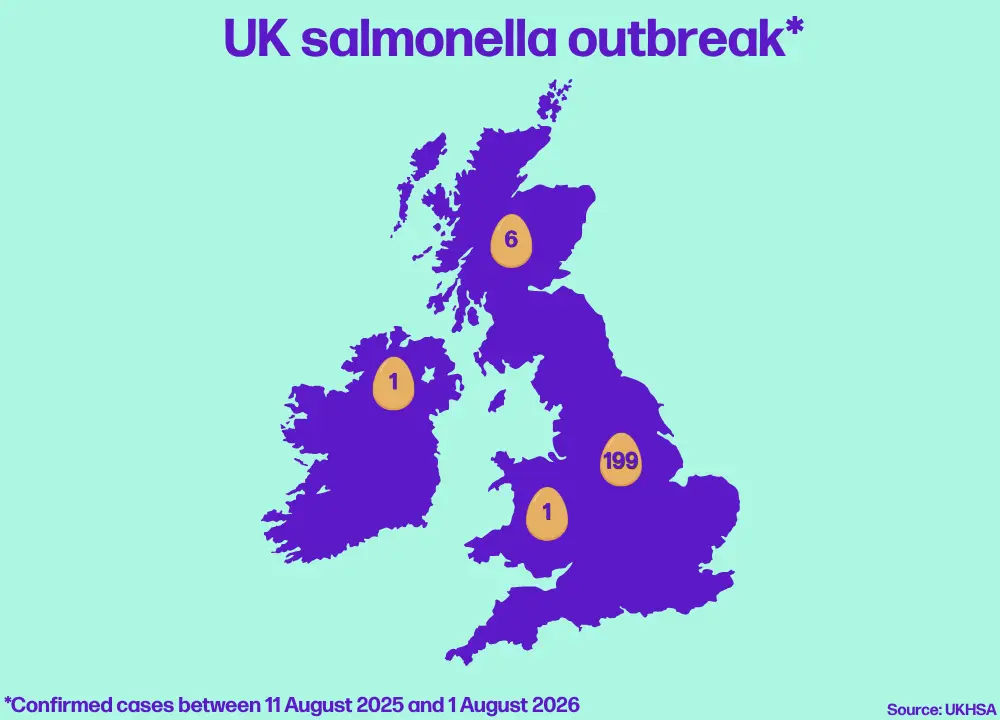
To break down the cases in the current outbreak, there have been 199 in England, six in Scotland, one in Wales, and one in Northern Ireland.
According to the UKHSA, it was London that registered the highest total among England, with 47 confirmed cases, while Yorkshire and Humber recorded 38.
The age of people affected ranged from babies to the elderly, as old as 90, while the data also suggests that people seem to have gotten ill after eating out rather than consuming food made at home.
The UKHSA has outlined that ‘extensive epidemiological and food chain investigations are ongoing to identify the source and origin of the contamination responsible for the illness’.
The Cleveland Clinic urges that while anyone can get Salmonella, you may be at a higher risk for infection or serious illness depending on your age, certain illnesses, and medications, such as taking antibiotics or having inflammatory bowel disease (IBD).
While it typically goes away on its own, Salmonella can become life-threatening for high-risk groups of people if severe dehydration or a bloodstream infection occurs.
Hannah Charles, lead epidemiologist for gastrointestinal infections at UKHSA, told ITV that ‘anyone who is concerned about symptoms should contact their GP or out-of-hours service in the first instance’.
Topics: UK News, News, Health, Food and Drink
 Madison Burgess