tyla homepage
  • News
  • Life
  • TV & Film
  • Beauty
  • Style
  • Home
  • News
    • Celebrity
    • Entertainment
    • Politics
    • Royal Family
  • Life
    • Animals
    • Food & Drink
    • Women's Health
    • Mental Health
    • Sex & Relationships
    • Travel
    • Real Life
  • TV & Film
    • True Crime
    • Documentaries
    • Netflix
    • BBC
    • ITV
    • Tyla Recommends
  • Beauty
    • Hair
    • Make-up
    • Skincare
  • Style
    • Home
    • Fashion
    • Shopping
  • Advertise
  • Terms
  • Privacy & Cookies
  • LADbible Group
  • LADbible
  • UNILAD
  • SPORTbible
  • GAMINGbible
  • UNILAD Tech
  • FOODbible
  • License Our Content
  • About Us & Contact
  • Jobs
  • Latest
  • Topics A-Z
  • Authors
Facebook
Instagram
X
Threads
TikTok
Submit Your Content
Little-known law means a lot of gay people can’t actually legally commit adultery

Home> Life> Sex & Relationships

Updated 09:34 19 Sep 2024 GMT+1Published 09:35 19 Sep 2024 GMT+1

Little-known law means a lot of gay people can’t actually legally commit adultery

The grounds for divorce can be very different when it comes to heterosexual and same-sex couples

Rhiannon Ingle

Rhiannon Ingle

google discoverFollow us on Google Discover

Can you imagine if your spouse cheated and you couldn't state adultery as the reason for divorce? Well, it turns out that a little-known UK law can actually cause this to happen, and it more commonly affects those in same-sex marriages.

While no one (hopefully) gets married with the intention of ever divorcing, it's sadly a fact of life with around nearly 50 percent of marriages ending in divorce.

But it turns out the perimeters surrounding legal grounds for divorce differ massively from heterosexual couples to same-sex couples.
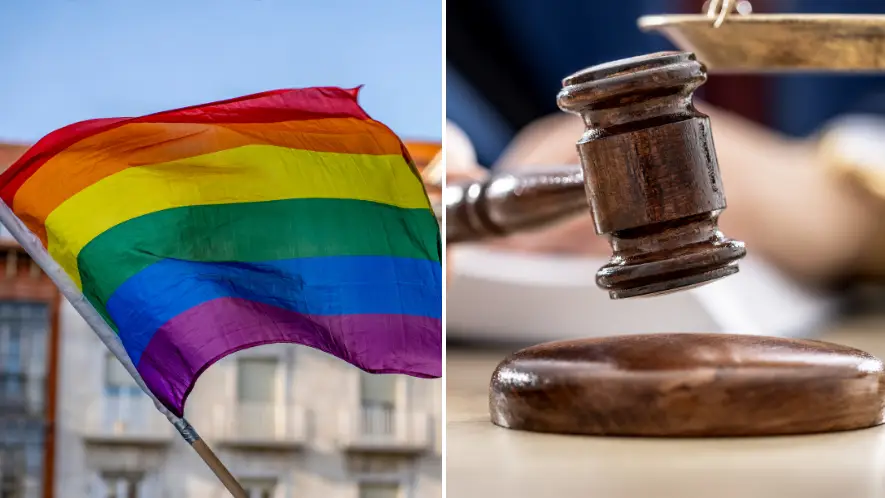
The grounds for divorce differ massively for heterosexual and same-sex couples (Getty Stock Images)

Advert

You can get divorced in England or Wales if you’ve been married for over a year, your relationship has 'permanently broken down' and if your marriage is legally recognised in the UK (including same-sex marriage).

There are currently five grounds to divorce in the UK which include:

  • unreasonable behaviour
  • abandonment
  • separation for two years
  • separation for five years
  • adultery

Interestingly though, the latter can't be used as a grounds for divorce for same sex couples.

The official Gov.uk website defines adultery as when 'your husband or wife had sex with someone else of the opposite sex, and you can no longer bear to live with them'.

Clearly, 'the opposite sex' totally excludes partners in same sex relationships.

The government then clarifies that 'it doesn’t count as adultery if they had sex with someone of the same sex'.

"This includes if you’re in a same-sex marriage," it adds.

This basically means that if a man cheated on his husband with another man, it would not count as adultery in the eyes of the law.

Equally, if a woman had a sexual affair with another woman, her wife wouldn't legally be able to say she had committed adultery.

It's all to do with what the law constitutes as consummation in a marriage (Getty Stock Images)

But, if that woman had sexual relations with another man outside of her marriage to her wife, she could cite adultery as grounds for divorce as he is a member of the opposite sex.

Of course, this would also mean that if a man cheated on his wife with another man, that too wouldn't fit the legal criteria for adultery.

So, what's the reasoning behind all this?

Well, it all comes down to what the law constitutes as consummation in a marriage.

At the moment, it can be defined fairly clearly with heterosexual couples.

However, the law seemingly finds it difficult to define what this means with same-sex couples.

So, when someone in a same sex marriage cheats, the law isn't able to legally recognise it as they cannot recognise the consummation of the initial marriage.

Same sex marriage was legalised in England when The Marriage (Same Sex Couples) Act was finally passed on 17 July 2013.

The first marriages of same sex couples took place the following year on Saturday 29 March 2014.

Featured Image Credit: Getty Stock Images

Topics: News, UK News, Sex and Relationships, Politics

Rhiannon Ingle
Rhiannon Ingle

Rhiannon Ingle is a Senior Journalist at Tyla, specialising in TV, film, travel, and culture. A graduate of the University of Manchester with a degree in English Literature, she honed her editorial skills as the Lifestyle Editor of The Mancunian, the UK’s largest student newspaper. With a keen eye for storytelling, Rhiannon brings fresh perspectives to her writing, blending critical insight with an engaging style. Her work captures the intersection of entertainment and real-world experiences.

Advert

Advert

Advert

Choose your content:

a day ago
2 days ago
  • Getty Stock Images
    a day ago

    Doctor issues warning to any women wearing ‘cheap’ knickers

    While it may be nice for your wallet, it's really not good for 'down there'

    Life
  • Getty Stock Image
    2 days ago

    ‘Matcha mouth’ explained as dentist issues ‘worrying’ warning over popular drink

    You may want to rethink your daily habit after this

    Life
  • Lacy Funeral Home
    2 days ago

    Parents of 9-year-old girl share warning after she dies doing ‘blackout’ social media 'challenge’

    JackLynn Blackwell tragically passed away last month (3 February)

    Life
  • Getty Stock Images
    2 days ago

    Bars urge people to stop common drinking habit after losing £130 million a year

    Good Morning Britain revealed just how common it is to do this one thing

    Life
  • Little-known ‘Nordic diet’ could help you live a lot longer
  • What UK’s Supreme Court ruling on definition of woman means for trans women and rights
  • Women’s uteruses can actually taste ‘bad’ sperm - here’s what it means
  • Same-sex marriage ruling from 2015 is suddenly at risk and people have one worrying question about what will happen