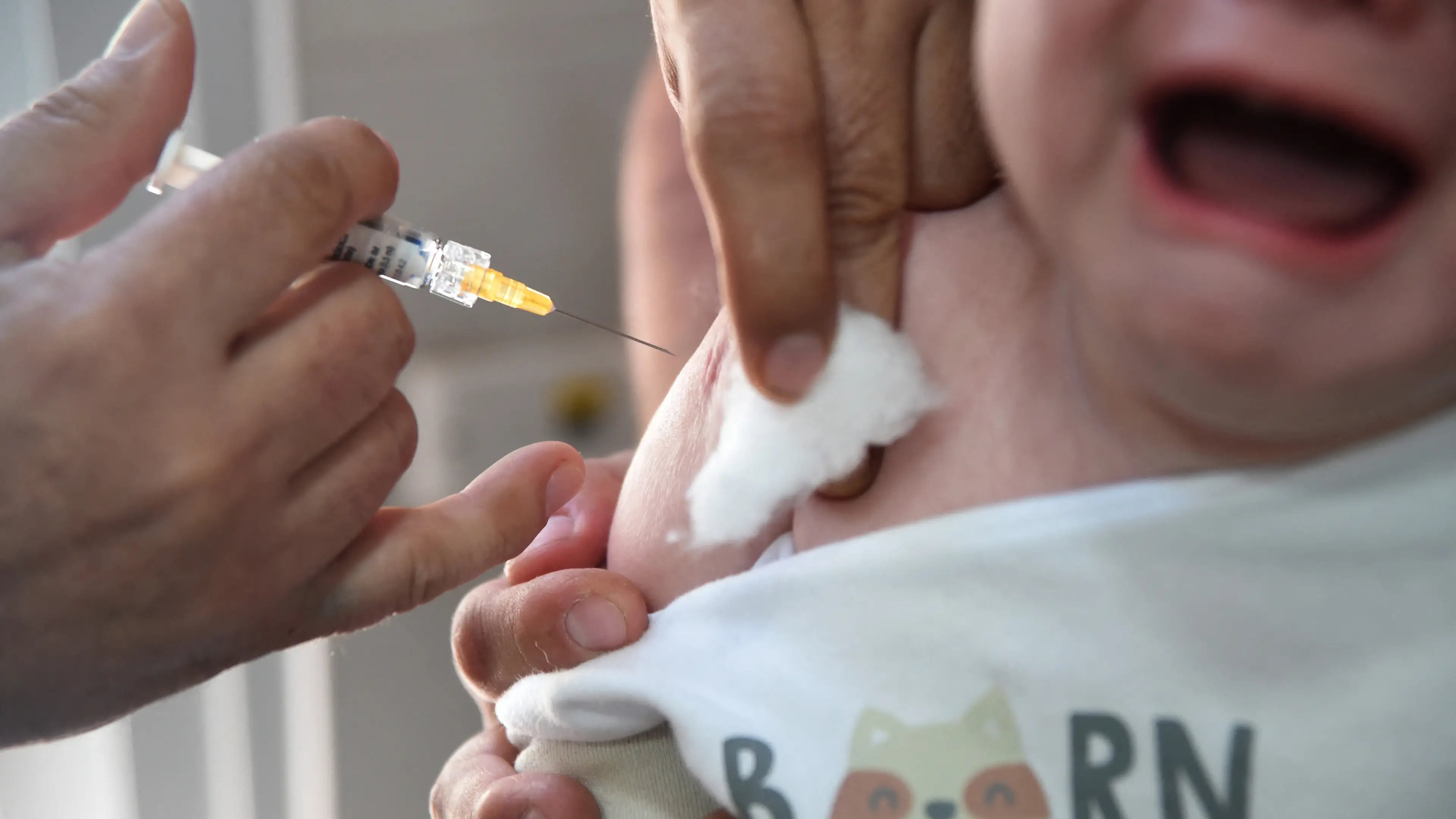
Why these six vaccines are no longer being recommended for kids

US childhood immunisation guidelines have changed, bringing experts together to criticise the decision that'll bring back 'suffering and death'.
The healthcare system has been changing since the presidential hands changed last year, and it’s for a few reasons.
When Donald Trump took over in Office for his second term in January 2025, he was quick to share what he believed would be the ideal future, and the science and medical industry was to play a big role.
From reclassifying cannabis for health and scientific reasons to appointing a controversial health official in his administration, Trump has been busy.
Advert
But now, the government has made a major move against vaccinations, by no longer recommending six out of its 17 childhood vaccines, which was led by a person who has been a public naysayer of vaccinations in general.
Shockingly, three of the vaccines no longer recommended have prevented nearly 2 million hospitalisations and more than 90,000 deaths in three decades, per the CDC's publications.
 The CDC revealed six vaccines that are no longer recommended to children (Getty Stock Images)Why were vaccinations stopped?
The new list was issued by the Centers for Disease Control and Prevention on Monday, 5 January, after the medications were assessed on their risks and ‘shared clinical decision-making' by parents and doctors.
The Health and Human Services Department said the changes came after a 'scientific review of the underlying science, comparing the US child and adolescent immunization schedule with those of peer, developed nations'.
While President Trump called the choice something that is 'rooted in the gold standard of science', the American Academy of Pediatrics described it as 'dangerous and unnecessary', per the BBC.
"We are aligning the US childhood vaccine schedule with international consensus while strengthening transparency and informed consent," said Secretary of Health and Human Services, Robert Kennedy Jr.
The department says it compared the US to 20 global nations like Britain, Canada, Denmark and Australia, which revealed that the US had more doses and vaccines than others.
With Denmark’s recommendation against 10 diseases, the US wanted to get as close to that smaller number as possible, and now they've gotten pretty close.
What vaccines are being stopped?
According to the CDC, hepatitis A, hepatitis B, influenza, meningococcal disease, rotavirus and respiratory syncytial virus will no longer be recommended for children in 2026 and going forward.
Instead, it stated that the only widely recommended vaccines for all children will include measles, mumps, rubella, polio, pertussis, tetanus, diphtheria, Haemophilus influenzae type B (Hib), pneumococcal disease, human papillomavirus (HPV), and varicella (chicken pox).
However, for those with high risk factors, respiratory syncytial virus (RSV), hepatitis A, hepatitis B, dengue, and meningococcal ACWY and meningococcal B will be offered.
Vaccines for Covid-19, influenza, and rotavirus will also be allowed at the discretion of parents and doctors.
What have the experts said?
The change has received a lot of backlash from healthcare professionals who are now worried about what it could mean for the future.

“They’re going to bring back suffering and death,” Dr Sean O’Leary told The Times. “I don’t say that with any hyperbole, that’s exactly what’s going to happen.”
Dr Nada Mallick, dual board-certified in general pediatrics and pediatric critical care at Children’s National Hospital, told The New York Post a similar sentiment about winter viruses that can be deadly to children.
“This raises public health concerns — particularly for influenza and RSV — as we enter peak winter season, when respiratory infections are already on the rise,” she said.
After the US compared its vaccination schedule to Denmark, a country of six million, while the US boasts 340 million people, Dr Andrew D. Racine, president of the American Academy of Pediatrics, criticised the move.
"The United States is not Denmark, and there is no reason to impose the Danish immunization schedule on America's families. America is a unique country, and Denmark's population, public health infrastructure, and disease-risk differ greatly from our own,” he said.
"At a time when parents, pediatricians and the public are looking for clear guidance and accurate information, this ill-considered decision will sow further chaos and confusion and erode confidence in immunizations."
He added. "This is no way to make our country healthier."
Topics: Donald Trump, Health, Politics, Parenting
 Britt Jones