
Women's G-spot has finally been found as first ever clitoris map unveiled

Scientists have mapped out the nerves of the clitoris for the first time ever, and it could have a groundbreaking impact on women's health.
The clitoris is one of the least-studied human organs, and shockingly, this new research comes a whopping three decades after the nerves of the penis were mapped out in a comprehensive study. This is largely down to a culture of stigma and taboo surrounding the female body, and this outdated way of thinking has held back scientific investigations.
To really put things into perspective, the clitoris didn't even make it into standard anatomy textbooks until the 20th century. Yes, really.
As reported by the publication, the new 3D model not only reveals the full extent of the nerves that are crucial to orgasms, but also proves that what medics are currently learning about the anatomy of the clitoris is wrong. It could also help prevent women who have pelvic operations from ending up with poorer sexual function.
Advert
Another indicator of how women's sexual health has been neglected is how little people know about the G-spot.

What is the G-spot, and where is it?
It's not a separate and specific part of the female anatomy, but is actually part of the larger clitoral network.
This means that when you’re stimulating it, you’re stimulating part of the clitoris, which, as we know, is much larger than it looks from the outside.
The pea-sized nub where the inner labia meet is only the tip and divides into roots that can be about four inches long.
As per Healthline, in one 2017 study, researchers attempted to find it, but came up empty-handed, so this new research could potentially pave the way for future scientific studies.
As mentioned, though, it's not a literal spot or button in your vagina, contrary to what some people may believe.
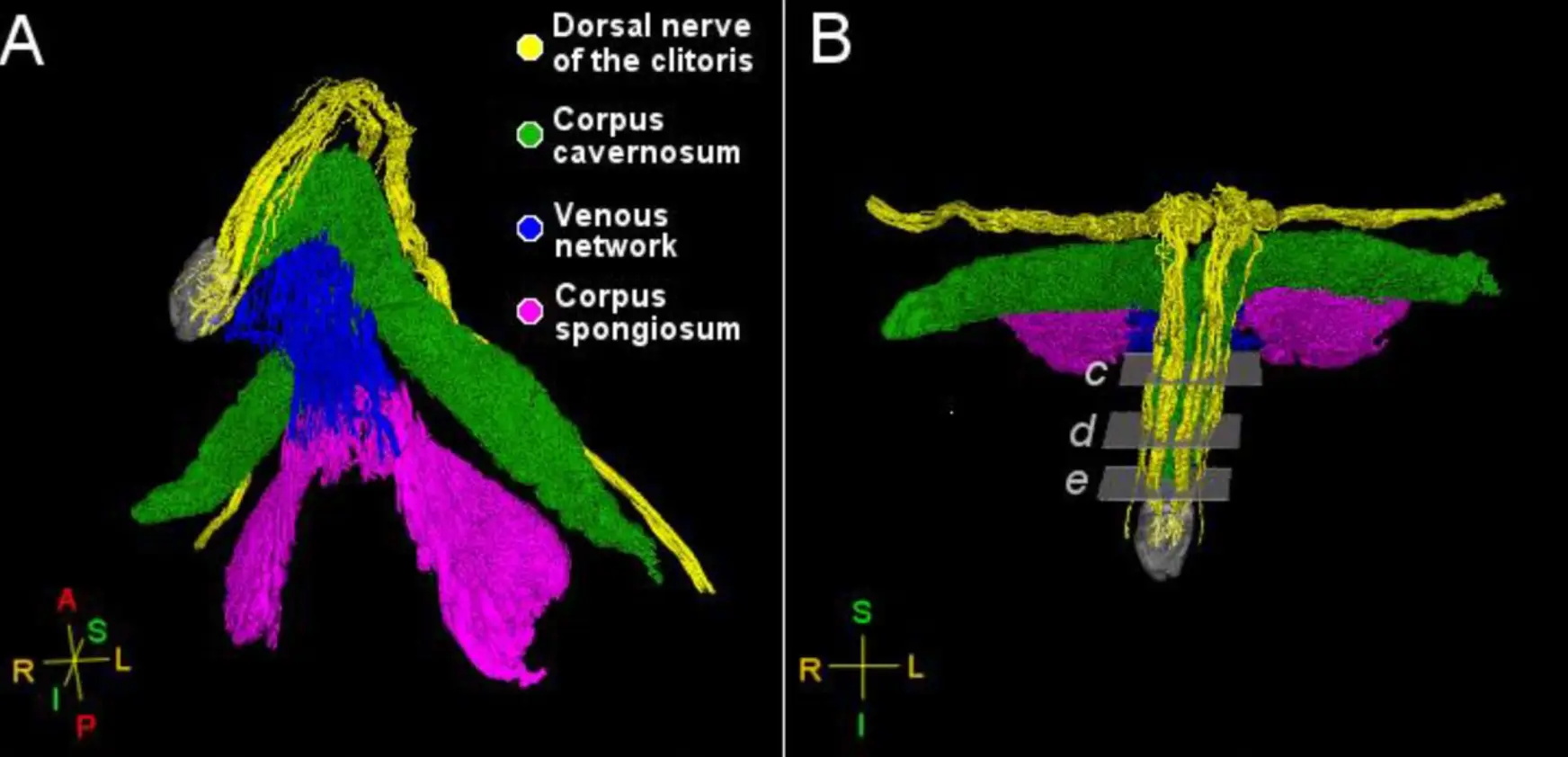
About the new research
And now, the new groundbreaking clitorial nerve map has given us a 3D trajectory of the complex nerve system.
The findings, which have not yet been peer-reviewed, were published on 20 March on the preprint server bioRxiv.
The study shows the trajectory of the five complex branching nerves that run through the organ, with the widest being 0.7mm across.
While prior studies claimed that the dorsal nerve tapers off as it nears the clitoral glans, the new imaging has revealed that, actually, it extends a robust array of branches into the glans, as outlined by Live Science.

Ju Young Lee, a research associate at Amsterdam University Medical Center in the Netherlands, explained how she and colleagues used high-energy X-rays to create 3D scans of two female pelvises that had been donated through a body donor organ programme.
While Georga Longhurst, the head of anatomical sciences at St George’s, University of London, told The Guardian: "I was especially fascinated by the high-resolution images within the glans, the most sensitive part of the clitoris, as these terminal nerve branches are impossible to see during dissection."
And the study's description reads: "These findings have an immediate impact on operations performed around the vulva area, such as gender-affirmation surgery and reconstruction surgery after genital mutilation."
Topics: Women's Health, Science, Health, Life, News, World News
 Madison Burgess