tyla homepage
  • News
  • Life
  • TV & Film
  • Beauty
  • Style
  • Home
  • News
    • Celebrity
    • Entertainment
    • Politics
    • Royal Family
  • Life
    • Animals
    • Food & Drink
    • Women's Health
    • Mental Health
    • Sex & Relationships
    • Travel
    • Real Life
  • TV & Film
    • True Crime
    • Documentaries
    • Netflix
    • BBC
    • ITV
    • Tyla Recommends
  • Beauty
    • Hair
    • Make-up
    • Skincare
  • Style
    • Home
    • Fashion
    • Shopping
  • Advertise
  • Terms
  • Privacy & Cookies
  • LADbible Group
  • LADbible
  • UNILAD
  • SPORTbible
  • GAMINGbible
  • UNILAD Tech
  • FOODbible
  • License Our Content
  • About Us & Contact
  • Jobs
  • Latest
  • Archive
  • Topics A-Z
  • Authors
Facebook
Instagram
X
Threads
TikTok
Submit Your Content
Shocking amount of time it could take ‘stranded’ NASA astronauts to recover from nine-month stay in space

Home> News

Updated 09:37 20 Mar 2025 GMTPublished 09:30 20 Mar 2025 GMT

Shocking amount of time it could take ‘stranded’ NASA astronauts to recover from nine-month stay in space

Just how long will it take for Sunita Williams and Butch Wilmore to recover from their NASA mission?

Jess Hardiman

Jess Hardiman

google discoverFollow us on Google Discover
Featured Image Credit: Keegan Barber/NASA via Getty Images

Topics: Space, Nasa, Health, Science

Jess Hardiman
Jess Hardiman

Jess is Entertainment Desk Lead at LADbible Group. She graduated from Manchester University with a degree in Film Studies, English Language and Linguistics. You can contact Jess at [email protected].

X

@Jess_Hardiman

Advert

Advert

Advert

After NASA astronauts Sunita Williams and Butch Wilmore finally landed home earlier this week to a heroes’ welcome, many people have been curious to know what the aftermath of space travel entails.

After all, it’s no small feat travelling out to the International Space Station, let alone spending a casual nine months there.

The pair’s mission was only supposed to last around a week, but their trip was unexpectedly extended when technical issues hampered things.

Thankfully, they can now be reunited with loved ones at home, and start returning to their normal lives.

Advert

But just how long does that adjustment take?

While only around 700 people have been to space, data is naturally fairly thin on the ground.

However, there’s a lot we know from astronauts who have previously visited, and have had to reacclimatise to Earth.
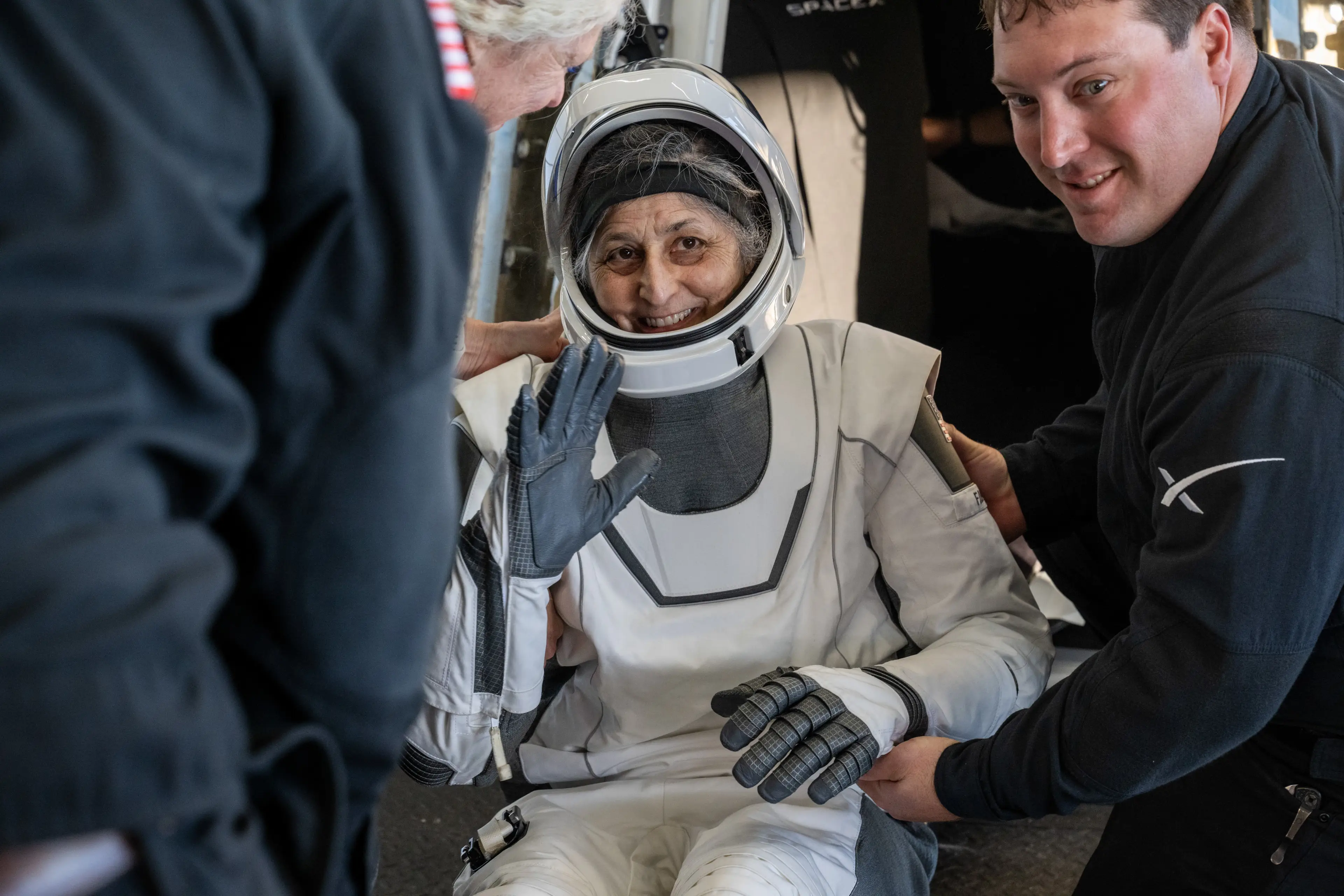
Sunita Williams after arriving back to Earth (NASA / Keegan Barber / Handout/Anadolu via Getty Images)

Upon immediately landing, there’s a risk of dizziness and nausea from the journey home - hence the stretchers Williams and Wilmore were placed on, as part of NASA protocol – which can take at least two or three days to settle, according to astronaut Tim Peake.

But there are other aspects that may take much longer to resolve, including muscle and bone loss.

A 2022 study documenting the latter in 17 ISS astronauts in missions that averaged five-and-a-half months found that, a year after returning, they exhibited on average 2.1 percent reduced bone density of the lower leg and 1.3 percent reduced bone strength.

Helen Sharman, who was the first Briton in space, told the BBC: "It will probably take them a few months to build up their muscle mass."

But she said bone mass could take ‘a couple of years’ until it recovers – and even then, there are often ‘subtle changes in the type of bone that we do rebuild after returning to Earth that may never return to completely normal’.
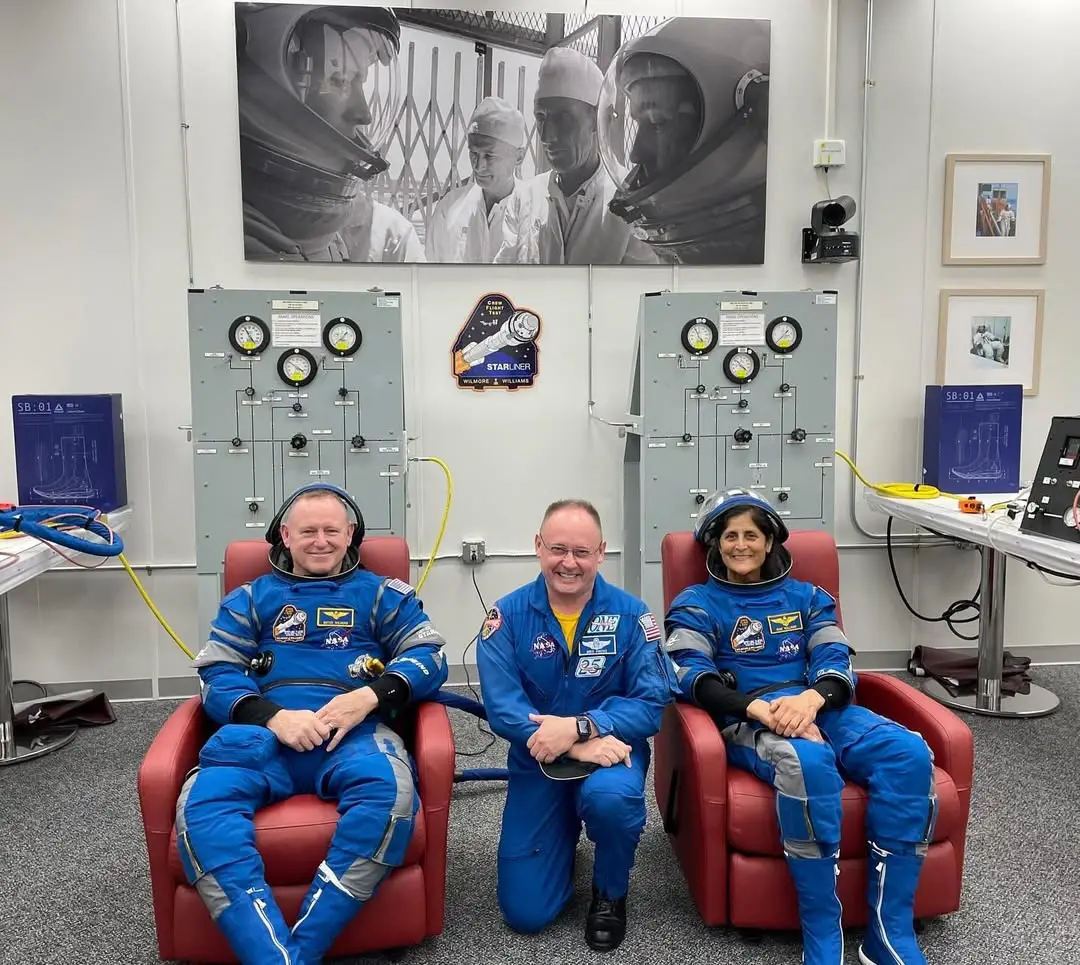
Williams and Wilmore last April before they set off (Instagram/@nasaastronauts)

Some people also face lasting eyesight impairment due to the way microgravity affects the eyes in space – a condition known as Spaceflight-Associated Neuro-Ocular Syndrome (SANS).

In general, NASA astronaut Frank Rubio, who returned from space in 2023 after 371 days away from Earth, told Time Magazine the adjustment to arriving home takes much longer than acclimatising to space.

He explained: "The first two or three months after your return is really focused on [recovery], just kind of reincorporating yourself into Earth, your family, and then also rehabilitating your body.

"You adapt incredibly quickly to being in space, but then unfortunately, the readaptation process back to earth can sometimes be a little bit longer and more difficult.

"And that's just, I think, because the forces of gravity and the forces at play here on Earth tend to have a stronger effect on your body.”

Of course, there’s also the psychological effects of space travel, which will obviously vary person-to-person.

Choose your content:

2 days ago
  • Getty Stock Images
    2 days ago

    Woman gets stuck in poop after getting trapped in outdoor toilet

    The unnamed woman was stuck for three hours in a outdoor loo located in the Australian outback

    News
  • wagonhoundoutfitters.com
    2 days ago

    Millionaire game hunter dies after being trampled on by herd of elephants

    The safari company he was hunting with have issued an update on his guide's health following the attack

    News
  • Facebook
    2 days ago

    Healthy mum ends life at Swiss clinic after sharing heartbreaking reason behind decision

    British mum Wendy Duffy, 56, has died at a clinic in Switzerland following the death of her son Marcus four years ago

    News
  • Alex Wong/Getty Images
    2 days ago

    White House issues hilarious response to toddler interrupting Trump’s announcement

    Two-year-old Travis Smith was pictured face-down in the Oval Office during a briefing with the media

    News
  • NASA left concerned after astronaut described sight he’d ‘never seen before’ during space trip
  • Artemis II astronauts' food menu for space mission revealed
  • How Artemis II astronauts will poop in space as crew make horrifying discovery within minutes of mission
  • NASA confirms Earth now has 'two moons' that will last until 2083