• News
  • Life
  • TV & Film
  • Beauty
  • Style
  • Home
  • News
    • Celebrity
    • Entertainment
    • Politics
    • Royal Family
  • Life
    • Animals
    • Food & Drink
    • Women's Health
    • Mental Health
    • Sex & Relationships
    • Travel
    • Real Life
  • TV & Film
    • True Crime
    • Documentaries
    • Netflix
    • BBC
    • ITV
    • Tyla Recommends
  • Beauty
    • Hair
    • Make-up
    • Skincare
  • Style
    • Home
    • Fashion
    • Shopping
  • Advertise
  • Terms
  • Privacy & Cookies
  • LADbible Group
  • LADbible
  • UNILAD
  • SPORTbible
  • GAMINGbible
  • UNILAD Tech
  • FOODbible
  • License Our Content
  • About Us & Contact
  • Jobs
  • Latest
  • Topics A-Z
  • Authors
Facebook
Instagram
X
Threads
TikTok
Submit Your Content
Seriously gross 'toilet plume' reveals why you should never flush with the seat up

Home> Life

Published 14:30 18 Jul 2025 GMT+1

Seriously gross 'toilet plume' reveals why you should never flush with the seat up

University of Colorado research alleges that waste particles are propelled as far as six feet when the toilet is flushed with the lid up

Rhianna Benson

Rhianna Benson

google discoverFollow us on Google Discover
Featured Image Credit: Getty Stock Image

Topics: Health, Life, Real Life, Science

Rhianna Benson
Rhianna Benson

Rhianna is an Entertainment Journalist at LADbible Group, working across LADbible, UNILAD and Tyla. She has a Masters in News Journalism from the University of Salford and a Masters in Ancient History from the University of Edinburgh. She previously worked as a Celebrity Reporter for OK! and New Magazines, and as a TV Writer for Reach PLC.

X

@rhiannaBjourno

Advert

Advert

Advert

Scientists have issued an urgent warning against flushing the toilet with the lid open, claiming it can release a potential dangerous 'toilet plume'.

So, first things first - what is a 'toilet plume?

According to Mechanical Engineering World, this eerie title is given to the tiny aerosolised particles that go flying around your bathroom once you've pulled the handle, which could be made up of bacteria, viruses, and pathogens.

Laser-based research from a study carried out by the University of Colorado alleges that waste particles are propelled as far as six feet from the toilet bowl by the turbulent flow generated by a flush.

Advert

Positioning a set of cameras in a dark room, droplets could be seen flying through the air in scenarios where the lid is not placed down, with lasers illuminating the extent of the spray.

The risks of these toilet particles

Occupational and environmental health scientist Evan Floyd discussed these findings, telling press, as per Smithsonian Magazine: "Most people don’t realise there are fine particles everywhere.

"It’s nice to have the quick visualisation."

The investigation also claims that these particles can be suspended for as many as several minutes, giving them enough time to land on a horde of bathroom surfaces, including toothbrushes, towels and countertops.

These particles could contain dangerous pathogens, including the likes of E. coli and Norovirus, which serve as a severe risk to health.

A 2021 study in the Physics of Fluids insists, therefore, that closing the lid prior to flushing can reduce this dispersal by as much as half.

The team also recommended the toilet seat be washed before use, as well as the hands being washed carefully after flushing.
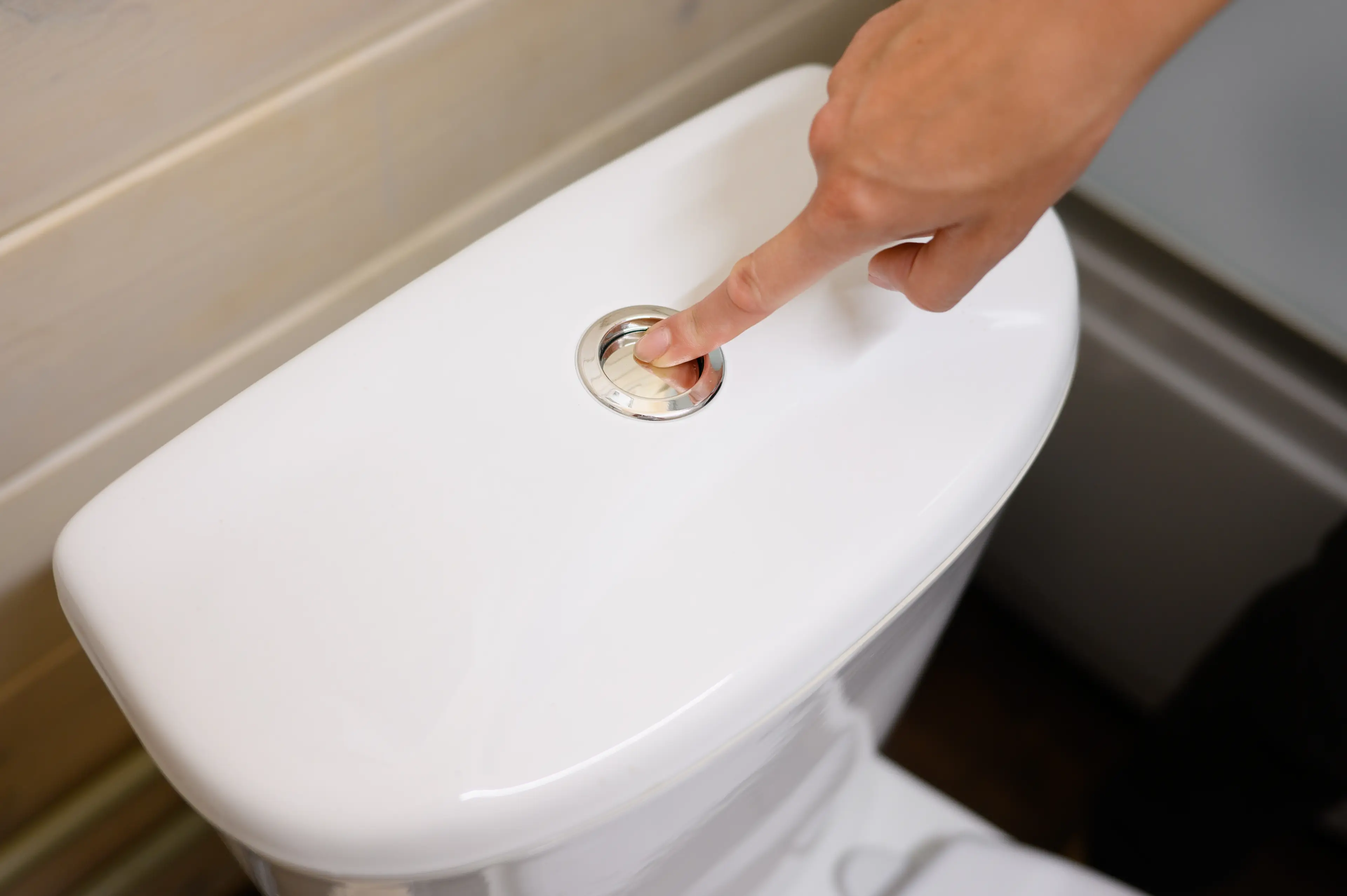
Should you put the seat up or down to flush? (Getty Stock Image)

Conflicting evidence

However, in a 2024 study, titled 'Impacts of lid closure during toilet flushing and of toilet bowl cleaning on viral contamination of surfaces in United States restrooms', scientists found that 'closing the toilet lid prior to flushing does not mitigate the risk of contaminating bathroom surfaces'.

Instead, the paper - published in the American Journal of Infection Control (AJIC) - recommends that you disinfect all bathroom surfaces (IE, toilet rim, floors) after flushing for the reduction of virus cross-contamination.

Having to wipe down every surface after you’ve used the toilet seems impossible, given that the average UK adult will use the toilet between four to ten times per day.

If you live with a partner, then that means you’d have to wipe down all surfaces between eight and 20 times per day if you wanted to reduce virus cross-contamination.
Some of the research has proven conflicting (Getty Stock Image)

So, what can you do instead?

The study stated that just cleaning the toilet with disinfectant and a brush reduced viral contamination by more than 99.99 percent.

Moreover, scientists suggested that by closing the toilet lid, you can potentially alter the direction of the aerosol plume.

Time to dig out the disinfectant, friends!

Choose your content:

20 hours ago
23 hours ago
a day ago
  • Getty Stock Images
    20 hours ago

    Gynaecologist warns against viral trend that can wreck ‘down there’

    The expert shared several reasons why you want to avoid using this specific product near your genitals

    Life
  • SWNS
    23 hours ago

    Man rushed to hospital after his skin turned blue - medics realised what really happened

    Tommy Lynch opened up about the alarming ordeal which took place

    Life
  • Getty Stock Images
    a day ago

    What it means to be ‘autosexual’ as expert explains common misconceptions about it

    Sexuality is a deeply personal thing, and there are many different classifications - many with misunderstandings

    Life
  • Getty Stock Images
    a day ago

    There are some signs of Parkinson’s disease that you wouldn’t even notice

    Approximately 166,000 people are currently living with the disease in the UK.

    Life
  • Why you should stockpile condoms if WW3 breaks out - it's not the reason you think
  • Why you should never take these supplements together at the same time
  • List of medications you should never mix ibuprofen or paracetamol with
  • Doctor shares weight loss jab side effects you should never ignore