
People outraged after non-human singer tops holiday charts

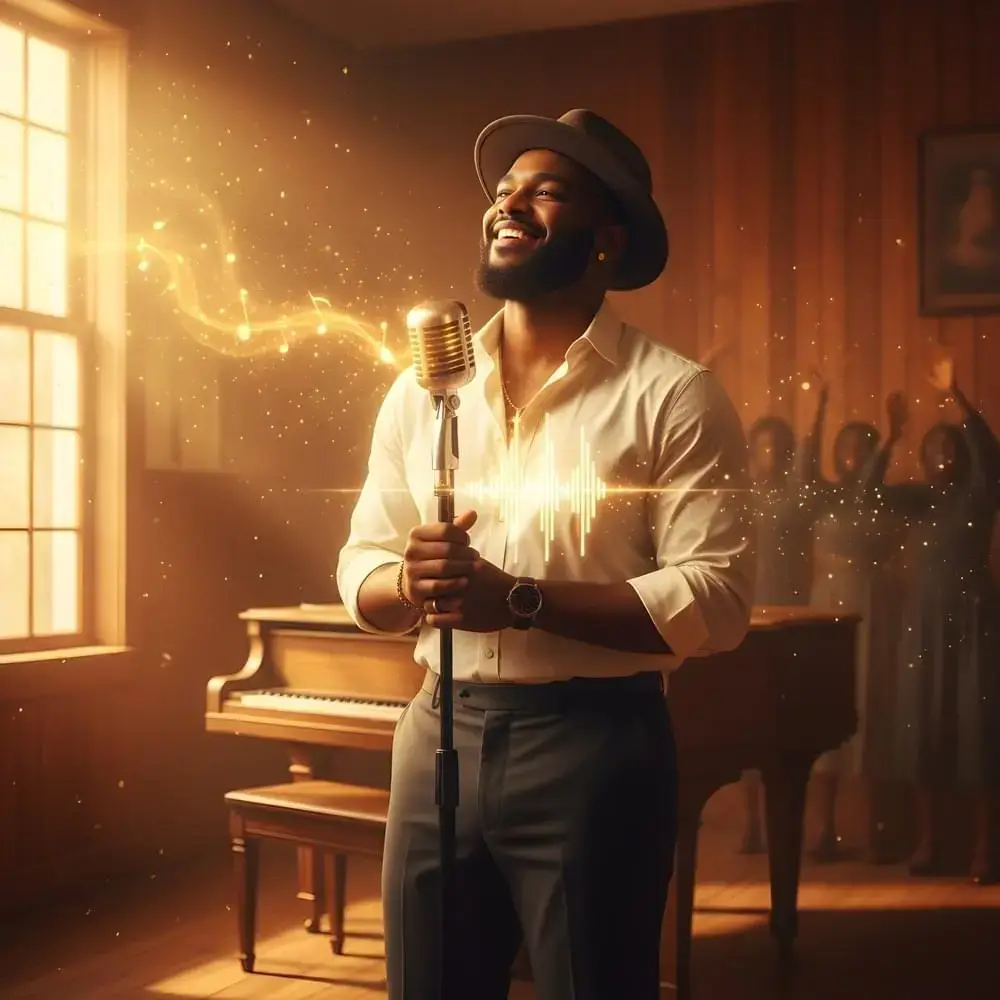
There's a musical newcomer who is tearing up the holiday charts with 'his' song currently holding the #1 Song and #1 Album spot on the iTunes Christian charts.
Over on Spotify, this so-called 'artist' has a whopping 579.8k monthly listeners with 'his' most famous track, titled 'Find Your Rest', having a staggering 1,075,636 listens. Not bad for 'someone' who's only been going for 20 days or so.
It's none other than Solomon Ray, whose Spotify bio reads: "Solomon Ray is a Mississippi-made soul singer carrying a Southern soul revival into the present. His records lean warm and analog—Hammond organ, honeyed horns, tambourine shake, live bass, and slide guitar—framing lyrics about faith, family, redemption, and real life.
"With a voice like weathered velvet and a storyteller’s cadence, he sings as if he’s testifying from experience: part Sunday-morning conviction, part Saturday-night grit."
Advert
The only kicker? He's completely artificially-generated.

Solomon's 61k-followers-strong Instagram, whose bio states 'AI Voice, Mississippi Soul', revealed earlier this week (19 November) that the AI-generated 'singer' had done pretty well for himself, with 'his' creator openly admitting the AI
"Currently, holding #1 Song + #1 Album on iTunes Christian charts simultaneously - (A FIRST FOR ANY AI ARTIST OF ANY GENRE)," the account wrote.
"Solomon Ray is no longer 'the AI experiment'. He is now the biggest new voice in gospel music – period.
"The future arrived faster than anyone expected. And his name is Solomon Ray. (All in under 21 days)."
Then, earlier this week, Solomon wrote in a follow-up post: "Last week, we celebrated making history on the iTunes Christian charts. This week, the blessings multiplied. Most Billboard placements for any AI artist. Higher peaks. More souls reached.
"And yes — the opposition grew too. But the grace of God outgrew it. Every obstacle only confirmed the assignment. Every critique only pushed the message further.
"The future of gospel music has a new chapter… and Solomon Ray is right in the middle of it."
After catching light of the news, critics rushed to social media to share their gripes with one Instagram user writing: "Screwing over human artists so humans can pay to hear a robot's feelings about God. No thanks."
"This is not a human. This is AI. How can that be Holy Spirit lead? I am deleting this!" fumed a second, while a third lamented: "Please step away from the AI."
A fourth chimed in: "Can't believe this is AI. I will not be listening any longer."
"AI gospel doesn't sit right with me," confessed another.
And a final critic outlined: "This isn’t music created from a soul, it’s artificially engineered. Just like genetically modified foods are everywhere, now they’re trying to feed us genetically modified sound… something designed in a system, not birthed from a human spirit.
"Think about it: music is supposed to carry emotion, creativity, purpose, a heartbeat. But AI tracks? They’re soulless. No spirit. No human intention. No connection to God."
Mind you, this comes amidst a long-spanning backlash and boycott against Spotify’s royalty structure, which pays artists approximately US$0.004 per stream.
Tracks must achieve over 1,000 streams before generating revenue, a threshold that excludes many independent musicians from monetisation entirely.
In a statement to Tyla, Christopher 'Topher' Townsend, the person who made Solomon Ray, said: "I fully understand why it's caused a big deal. Any time something new disrupts an established space — especially something as personal as music — emotions are going to run high.
"But here’s the reality: I’m not here to replace artists. I’m not here to take opportunities away from anyone. I’m here because music has always been my way of serving people, and these tools simply allow me to reach hearts in a different way.
"People aren’t connecting with 'an AI singer'. They’re connecting with the stories, faith, and soul behind the songs. And that humanity — the testimony, the struggle, the gratitude — that all comes from a very real place. I understand your worries and am open to having an honest conversation.
"In the end, though, the charts didn't move because of controversy. They moved because people chose the music, shared it, and got something from it. To keep giving people who need it hope, courage, and faith, I will use everything I have."
Tyla has reached out to Spotify and Apple Music for comment.
Topics: Music, Technology, Artificial intelligence, Celebrity, Social Media
 Rhiannon Ingle